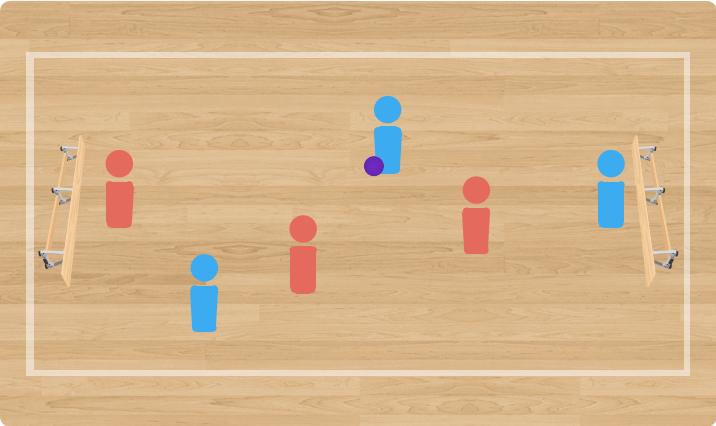
Invasion

Bottle Ball

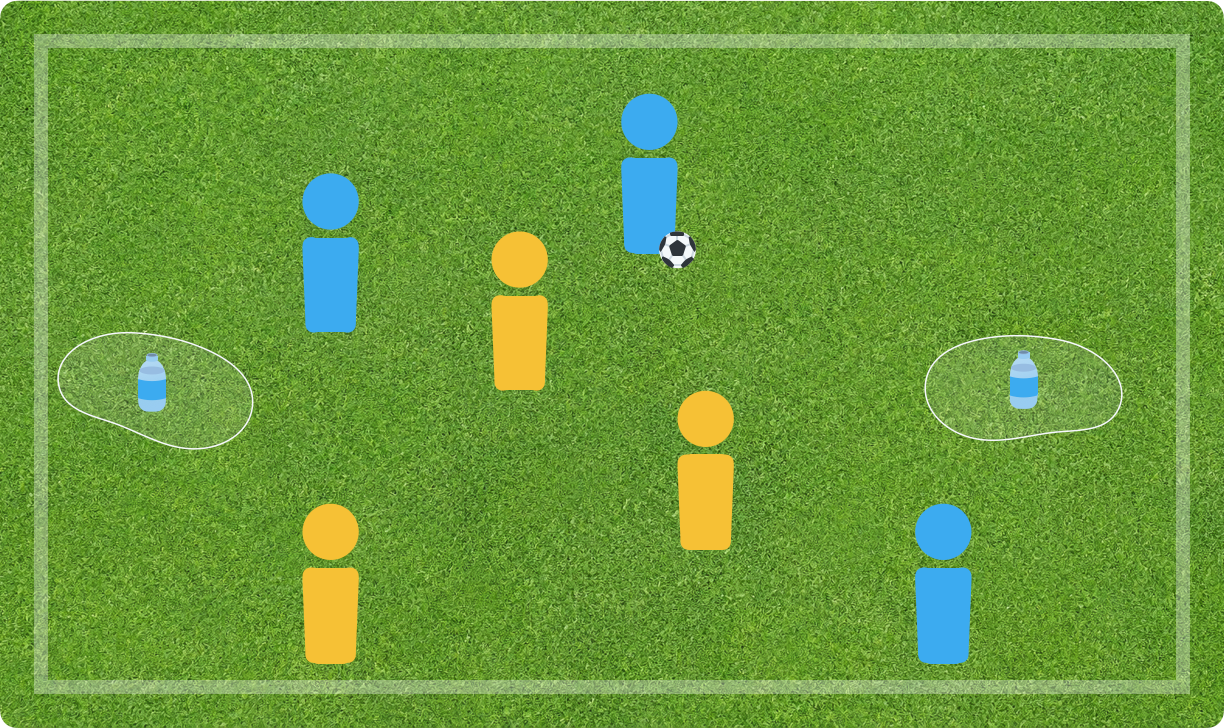
Bottle Ball is an invasion game where teams defend a two-litre water bottle instead of a net. Every goal knocks the bottle over and spills some water, so the scoreboard sits right there on the field for everyone to see.
Learning Targets

I can send the ball accurately to a teammate, a goal, or a target.
I know the cues for passing a ball with accuracy.
I understand how to adapt my passing technique to send the ball with power, accuracy, or both.

Game Overview

Play Area
  • Mark out a rectangular playing area using field lines, flags, cones, or rope.
  • At each end, lay a 33' rope on the ground in a circle to create a goal circle roughly 10' across.
  • Place a two-litre bottle in the centre of each circle, filled two-thirds with water, cap off.
Goal
  • Knock over your opponents' bottle while protecting your own. The team with the most water left at the end wins.
Play
  • Teams of three play soccer within the boundaries, using standard soccer rules for handling and contact.
  • No player may enter a goal circle. The only exception is a defender retrieving a ball that has come to rest inside their own.
  • A goal is scored by knocking the opponents' bottle over with the ball.
  • After a goal, the team that was scored on stands their bottle back up and restarts from their circle. The team that scored must retreat to their own rope before rejoining play.
  • If the ball leaves the playing area, play restarts with a pass-in from the line. There are no throw-ins.
  • Play for a set amount of time, then compare bottles.

Equipment

  • Size 4 or 5 soccer balls (one per game)
  • 33' ropes, one per team (spot markers or cones work too)
  • Two-litre plastic bottles with caps, one per team
  • Rubber bands, one per bottle
  • Water and a jug for refilling between rounds
  • Pinnies in four colours
  • Cones, flags, or field lines

Assessment Ideas

  • Observation Tools (e.g. a Passing for Accuracy Assessment Tool) can be used to assess whether players are applying the cues when they send the ball.
  • Peer Assessment Tools can be used to assess a teammate's passing technique while teams rotate off the field.
  • Exit Tickets can be used to assess whether students can explain when they would choose power over accuracy and why.

Safety

Play on grass or another surface where spilled water will not create a slip hazard. If you play indoors, keep a mop nearby or fill the bottles with sand and score by counting goals instead.

Use plastic bottles only, never glass.

Shots at the bottle should be kept along the ground.

No player enters a goal circle except a defender retrieving a stopped ball, and everyone else gives them space to do it.

Standard soccer contact rules apply. No slide tackles.

Teacher Notes

Slide a rubber band around each bottle and set it at the water line before you start. Every time a team gets scored on and stands their bottle back up, they roll their rubber band down to the new water line. It gives each team a clear marker of where they started and how much they have lost, and it makes the final comparison at the end of the game quick and obvious.

Printable Game Sheet

Hand this to a sub and walk away. Printable pages for every build, diagrams,  discussion questions, teacher notes, and assessment ideas. All in one ready-to-print package so there's no sub plan to write.

$4
USD · instant download
Add to cart
OR NEVER PAY FOR ONE AGAIN

#PhysEdU Plus includes instant access to every printable game sheet in ThePhysicalEducator.com's games database. $49 a year.

See what's in Plus

Game Builds

Builds allow you to increase the game's complexity, one layer at a time.
1
Build
1

Caps On

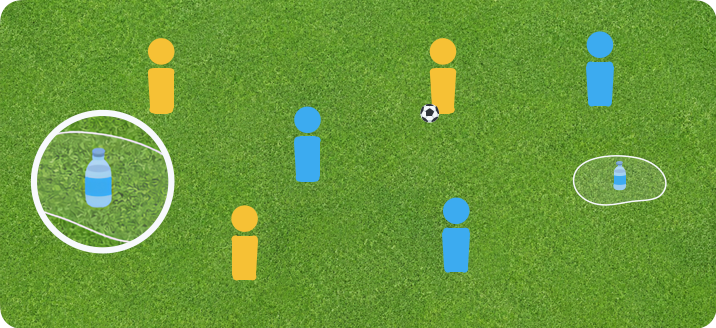
Teams of three play the full game with the caps left on the bottles. Nothing spills, so a goal simply resets the play and the game runs back and forth.

Teams keep track of how many times they knock the other bottle over, and the team with the most goals at the end wins.
Discussion Questions

  • What did you pay attention to when you were lining up a shot at the bottle?
  • Was your best pass to a teammate the same kind of pass as your best shot at the bottle? What was different about them?

Assessment Ideas

  • Self-Assessment Checklists can be used to assess whether students can identify the cues they are using to send the ball with accuracy.
2
Build
2

Bottle Ball

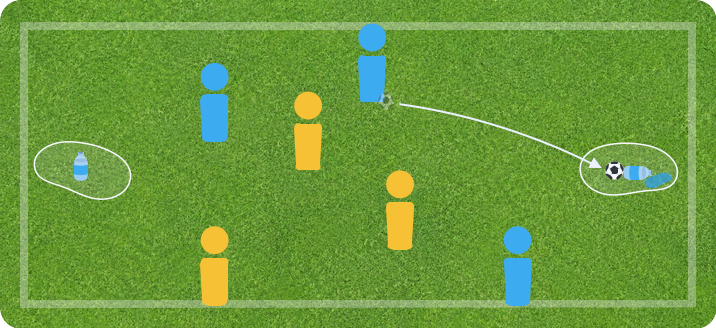
Play the game again, this time with the caps off. Every goal now costs the team that was scored on some of their water, and the team with the most water left at the end wins.

Because the water is visible from anywhere on the field, teams can see exactly where they stand at all times, which tends to change how they play as the game goes on.
Discussion Questions

  • How did taking the caps off change the way your team played?
  • When did you choose to hit the bottle hard, and when did you choose to place your shot instead?
  • How did your team decide when to send someone forward and when to hold back and protect the bottle?

Assessment Ideas

  • Exit Tickets can be used to assess whether students can describe how they adapted their technique for power, accuracy, or both.
3
Build
3

Omega Bottle Ball

This build takes its inspiration from OmegaBall, a version of soccer played on a circular pitch with more than two teams. Instead of running two separate games, combine them into one.

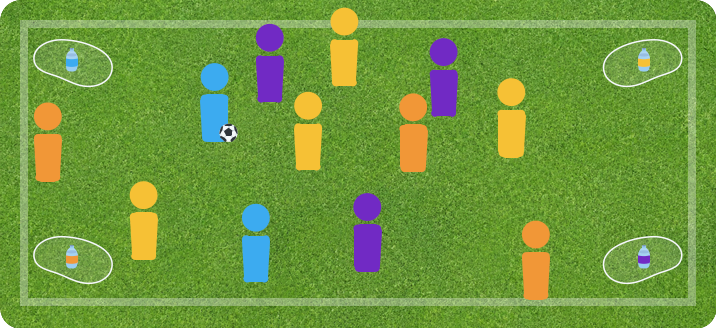
Mark out a large circular playing area and place four goal circles evenly around its edge, each with a bottle inside and the cap off. Four teams of three play at once with a single ball. Every team defends their own bottle and may score on any of the other three.

All of the rules from build two still apply. Nobody enters a goal circle, the team that was scored on stands their bottle up and restarts from their circle, and the team that scored retreats to their own rope before rejoining. There are no offsides and no throw-ins. When time is up, the team with the most water left in their bottle wins.

Because there are three targets to choose from at any moment, players have to keep their heads up and move the ball quickly to wherever the opening is. Passes need to travel further and arrive faster than they did in the two-team game.

Discussion Questions

  • How did you decide which bottle to attack?
  • What made a good pass in this build different from a good pass in the last one?
  • How did your team protect your own bottle while three other teams were looking for a chance to score?

Assessment Ideas

  • Video Analysis can be used to assess whether students are adjusting the power and accuracy of their passes to suit the distance and the situation.
  • Peer Assessment Tools can be used to assess passing technique from the sideline while teams rotate.

Away on Thursday?

Print the game sheet, leave it on your desk, and your sub has everything they need: the diagrams, the builds in order, what to say, and what to watch for. This one is $4. #PhysEdU Plus members get all 39, free forever, for $49 a year.

More
Invasion
Games

Games that build on the same tactics.