Turn a two-litre water bottle into a goal your students can read from across the field with this printable game pack for Bottle Ball, an invasion game where every goal spills the evidence.
Most PE scoreboards live in the teacher's head.
You call out the score every few minutes, a couple of kids are keeping their own count, and somebody always asks who's winning about four seconds after you told them. The score is real, but it isn't visible, and a thing students can't see is a thing they can't play against.
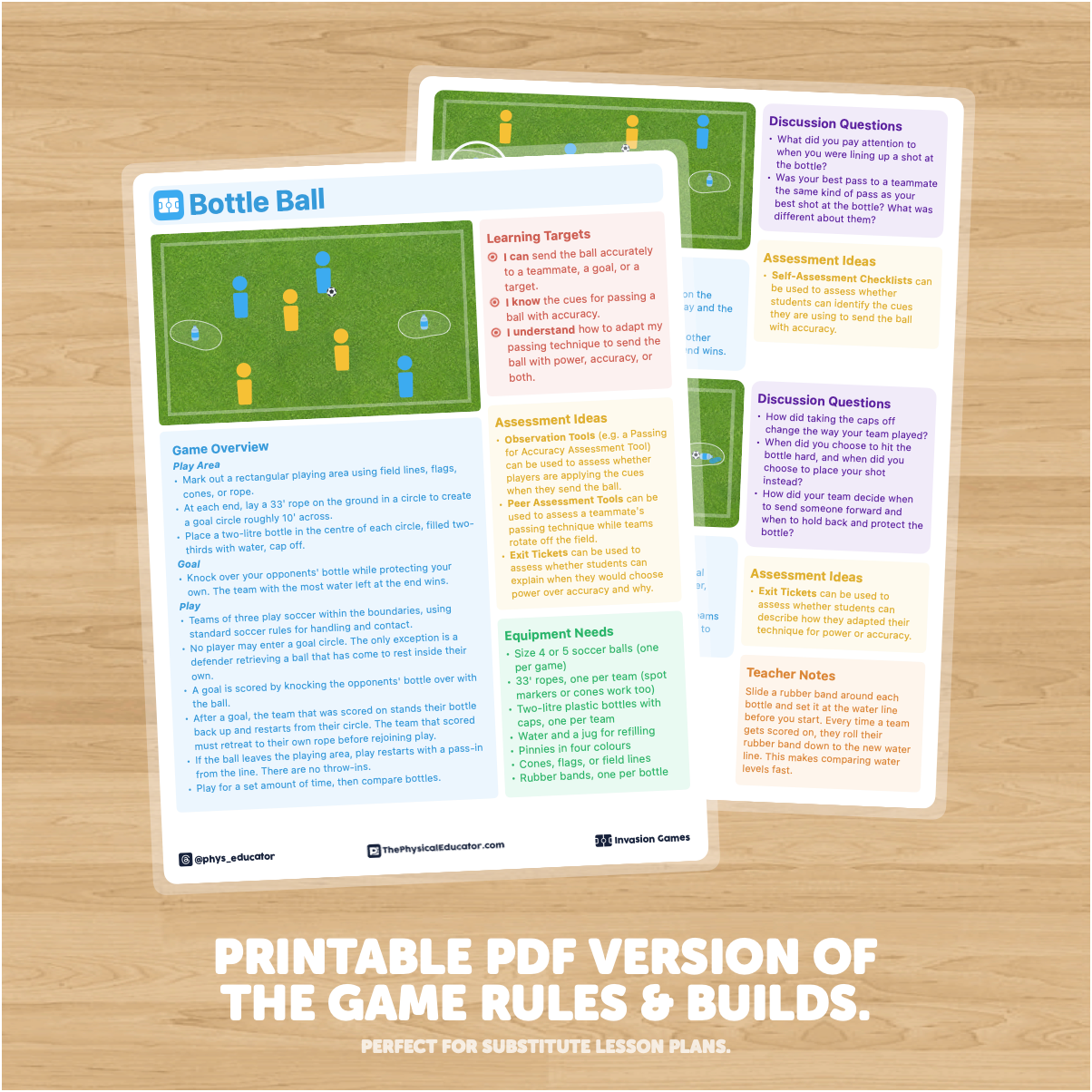
Bottle Ball puts the scoreboard on the field. Each team defends a two-litre bottle sitting in the middle of a rope circle, and a goal means knocking that bottle over. Caps are off, so every goal spills. At the end of the game, the team with the most water left wins.
That one mechanic changes how the game feels. Students can look across the field and see exactly how much they have left to protect, and you can watch a team's whole approach shift when their bottle starts running low. Nobody has to be told the score.
The rope circle does quiet work too. It's a goal area nobody may enter, which means there's no goalkeeper, and it means a defending team has to protect their bottle by controlling the space around it rather than by standing in front of it.
🧢 Build One: Caps On. The full game with the caps left on. Nothing spills, goals just reset the play, and students get to work out how to knock a bottle over before anything is riding on it.
💧 Build Two: Bottle Ball. Caps come off and the water starts counting. Same game, completely different decisions.
⚽ Build Three: Omega Bottle Ball. Four teams, four bottles, one ball, on a circular pitch borrowed from OmegaBall. Every team can score on any of the other three, which means passes travel further, arrive faster, and only work if the player sending them has their head up.
The learning targets sit on passing with accuracy, and the third build is what makes them bite. A pass that would have been fine in a two-team game gets picked off in a four-team one, so students have to start weighing power against accuracy rather than just kicking harder.
The pack includes the full game, all three builds with their diagrams, learning targets, discussion questions, assessment ideas, and teacher notes.
Happy Teaching!
Buying the paid ones individually comes to over $400. #PhysEdU Pro puts the whole library in your account for $99 a year.