Invasion

Benchball

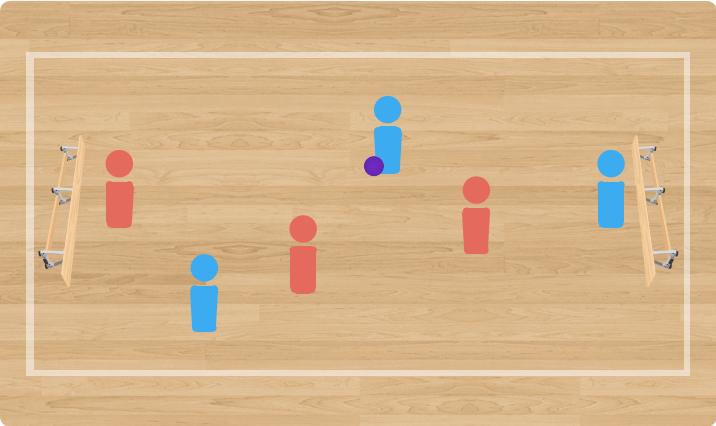
Benchball is an invasion game in which teams score by kicking the ball into the face of their opponent's bench. Students learn to work toward a shared team goal, first without positions and then with assigned roles that depend on each other.
Learning Targets

I can play my part by working toward my team's goal during a game.
I know that when it's my turn to play, my job is to work toward my team's goal.
I understand that the choices I make during a game affect my teammates.

Game Overview

Play Area

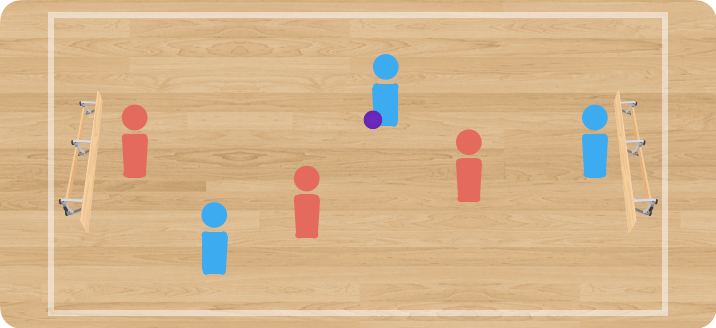
The game is played on a rectangular playing area with one tipped-over gymnasium bench at each end.

Goal

Teams try to outscore the other team by kicking the ball so that it hits the face of the opposing team's bench.

Play
  • Players may not use their hands at any time during play. To move the ball, players must use their feet.
  • To score a goal, a player must kick the ball so that it hits the face of the opposing team's bench (the seat surface).
  • To start or restart play after a goal, the team with the ball completes a back pass from centre court: the player with the ball must pass it backward to a teammate before the team can advance.
  • If the ball goes out of bounds or a player uses their hands or commits a foul, the other team receives a free pass. The free pass is taken from the spot where the violation occurred, or from the nearest in-bounds spot if the ball went out.
  • During a free pass, all defending players must be at least five big steps away. The player taking the free pass must pass the ball to a teammate before play continues.

Equipment

  • Foam soccer balls or playground balls (one per game)
  • Pinnies (one set per team)
  • Gym benches (two per game)

Assessment Ideas

  • Observation Tool can be used to assess whether students are working toward their team's goal during play.
  • Exit Tickets can be used to assess whether students can name their role and describe what it looks like in the game.
  • Peer Assessment can be used to assess whether students can recognize a teammate playing their part and give specific feedback about it.

Safety

  • Kicked balls must stay below hip level. The bench is a low target and the ball travels quickly along the floor.
  • No body contact. The back pass restart exists to slow the game down, so hold students to it rather than letting play run continuously.
  • Students may not stand, sit, or climb on the tipped-over benches at any point during play.

Printable Game Sheet

Hand this to a sub and walk away. Printable pages for every build, diagrams,  discussion questions, teacher notes, and assessment ideas. All in one ready-to-print package so there's no sub plan to write.

$4
USD · instant download
Add to cart
OR NEVER PAY FOR ONE AGAIN

#PhysEdU Plus includes instant access to every printable game sheet in ThePhysicalEducator.com's games database. $49 a year.

See what's in Plus

Game Builds

Builds allow you to increase the game's complexity, one layer at a time.
1
Build
1

Benchball Free-For-All

Players from each team take to the court (three per team) and play the full game without any assigned positions.

The focus is on learning how the game works: how to score, how to start and restart play, what counts as a foul, and how the boundaries work.
Discussion Questions

  • How did your team try to score a goal? What worked?
  • What was one rule that helped you figure out what to do during the game?

Assessment Ideas

  • Teacher Observation can be used to assess whether students understand the basic rules and are able to participate in the flow of play.
2
Build
2

Benchball Roles

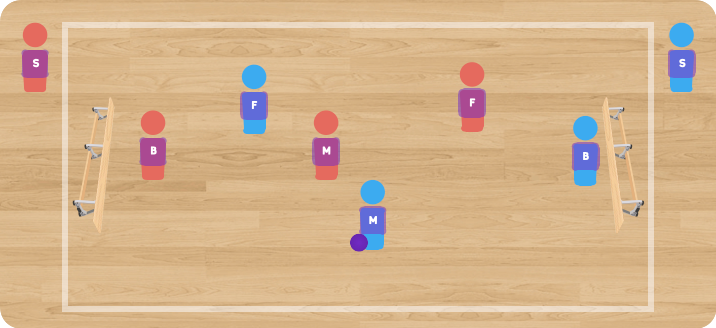
In this build, each team of four players takes on specific positions. Review each role with students before play begins.

Forwards: The forward's job is to score.

Backs: The back's job is to defend the team's bench.

Middles: The middle's job is to support both the backs and the forwards.

Bench Player: The bench player waits on the sideline, ready to substitute in. Their job is to pay attention to the game, cheer their team on, and be ready when it's their turn.

Rotate positions regularly so that every student gets to experience each role.

Discussion Questions

  • What was your job in this build? How did knowing your job change the way you played?
  • Which position felt the most connected to your teammates? Why?

Assessment Ideas

  • Exit Tickets can be used to assess whether students can describe their position's role and explain how it connects to the team's goal.
  • Peer Assessment can be used to assess whether students recognize a teammate doing their job well and can name a specific example.

Teacher Notes

Numbered pinnies go a long way in helping students know their position assignments.

Away on Thursday?

Print the game sheet, leave it on your desk, and your sub has everything they need: the diagrams, the builds in order, what to say, and what to watch for. This one is $4. #PhysEdU Plus members get all 39, free forever, for $49 a year.

More
Invasion
Games

Games that build on the same tactics.