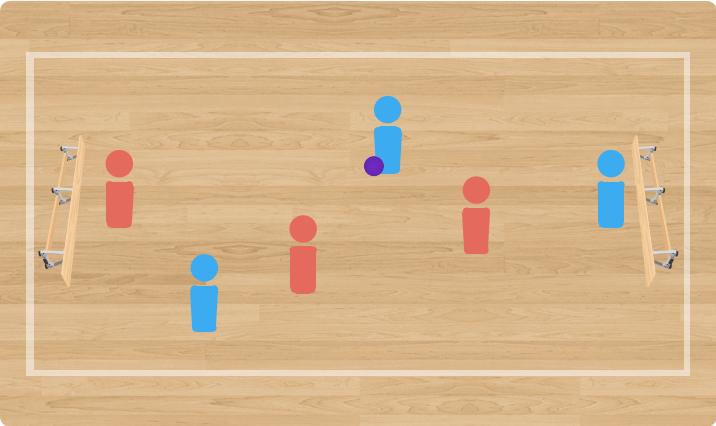
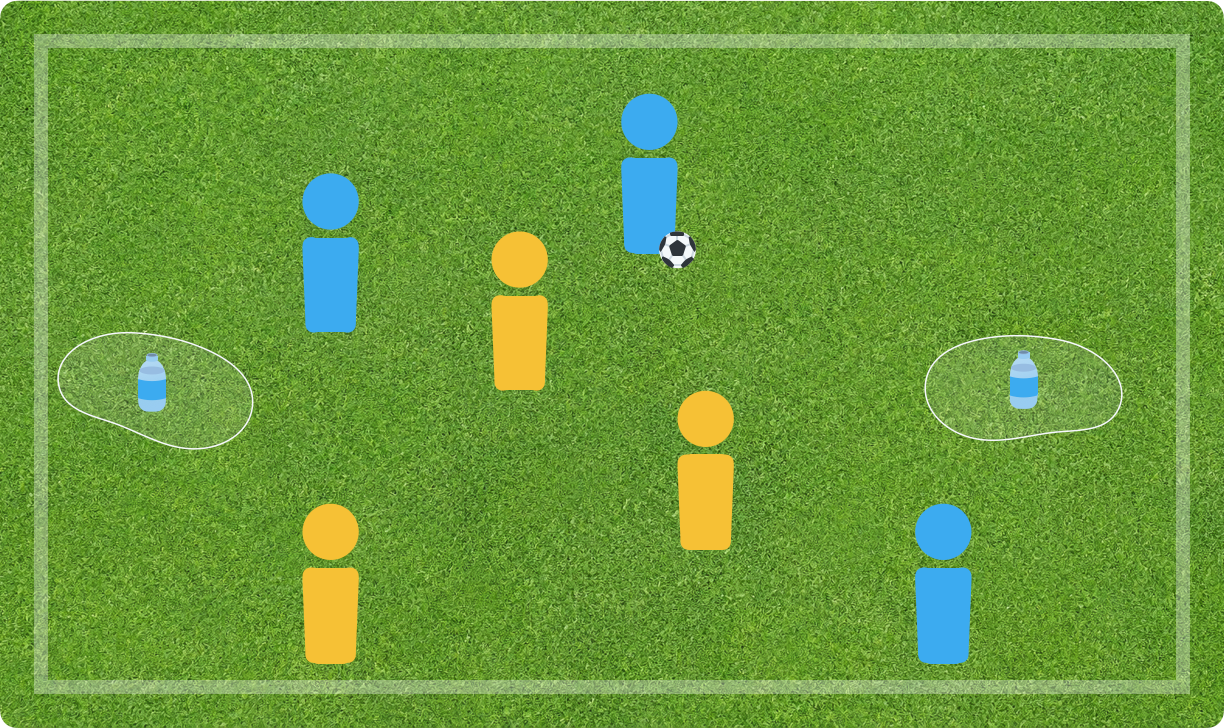
Can you grow you Prairie Dog nest into a massive colony? Prairie Dog Pickoff will have students progressively developing their invasion game tactics through a variety of fun, challenging game situations.
Students should aim downwards as they throw the ball to attack.
Students should avoid contact with others.
Students may not jump into other team’s nests/colonies/bases.
Hand this to a sub and walk away. Printable pages for every build, diagrams, discussion questions, teacher notes, and assessment ideas. All in one ready-to-print package so there's no sub plan to write.
#PhysEdU Plus includes instant access to every printable game sheet in ThePhysicalEducator.com's games database. $49 a year.
Builds allow you to increase the game's complexity, one layer at a time.
Each student is given a hoop and a foamie or thin pin. Students set up in a scattered formation, placing their hoop on the ground with the pin standing in the centre. The pins are their Prairie Dogs and the hoops are the nests. Students may not stand in or over a nest at any time.
On the teacher's signal, students get into a defensive ready position and begin sliding around their nest. When the teacher calls "GET MOVING", students have five seconds to pick up their prairie dog and nest, move to a new open space, set up again, and resume sliding in a ready position.
The teacher keeps calling "GET MOVING" and can adjust how much time students are given to find a new space.
At the end of the round, the class discusses the tactics they used to identify and move to open space quickly.
Shortening the five seconds is the simplest way to raise the pressure here. It forces students to be scanning for their next space while they are still defending their current one.
The teacher adds a few gator balls to the game.
Students now attempt to knock over their opponents' prairie dogs while continuing to defend their own. A student may leave their nest to collect a ball, but once the ball is in their hands their movement is limited to pivoting. A player in possession may throw or roll the ball to try to knock over an opponent's prairie dog.
If a prairie dog is knocked over, its owner picks up their foamie and hoop and moves to a new open space before continuing to play.
At the end of the round, the class discusses the tactics they used to attack and the tactics they used to defend.
Players continue as in Build Two. However, a player who knocks over another player's prairie dog must now signal to that player that they have done so.
A player whose prairie dog is knocked over takes their hoop and foamie and sets up so that their hoop touches the hoop of the player who knocked it over. Those two players are now building a colony, and the goal of this build is to see how large a colony they can create and defend.
If a player within a colony has their prairie dog knocked over, they leave and join the player or players who did it. If several players are knocked over at once, they all leave together.
If a player is knocked over but is unsure who did it, they simply leave the colony and set up on their own in an open space.
Colony members may pass to each other to get closer to the prairie dogs they want to target, though movement is still limited to pivoting while in possession.
The teacher pauses the game once only two or three colonies remain. Using small cones, the teacher marks off the perimeter of each colony, which becomes the outer edge of that colony's base.
The teacher then removes all of the gator balls from the game except one.
Once the bases are set, the teacher removes all of the hoops that formed each colony along with all but two or three foamies, which are left standing in the centre of the base. As with the hoops, players may not step inside their base unless they are retrieving a dead ball.
Play resumes, with colonies competing to be the last team with prairie dogs still standing in their base.
Dropping to a single ball is what turns this build into a genuine team defence problem. With one ball in play, every colony has to decide whether to chase possession or hold their shape.
Print the game sheet, leave it on your desk, and your sub has everything they need: the diagrams, the builds in order, what to say, and what to watch for. This one is $4. #PhysEdU Plus members get all 39, free forever, for $49 a year.
Games that build on the same tactics.