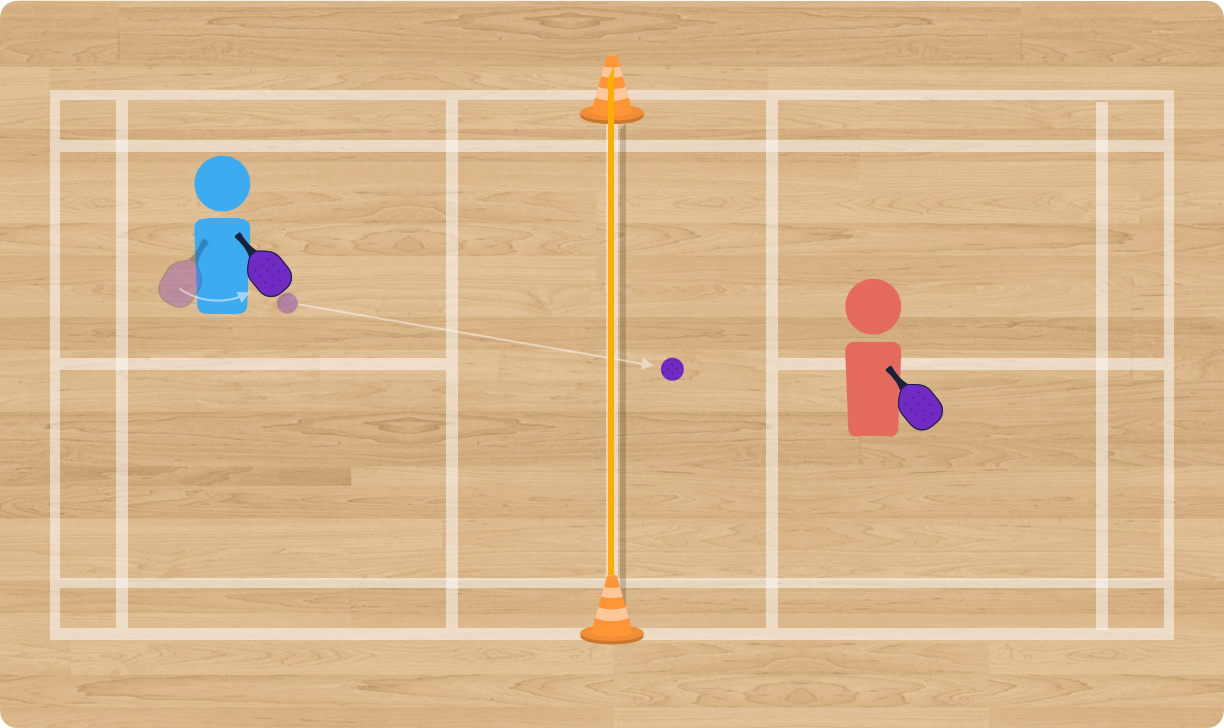
Zoneminton is a perfect activity for helping students explore net and wall game tactics, especially in regard to creating and attacking open space. The game's simplicity is what makes it so accessible to students, not to mention fun!
Students should not interfere or step into another pair’s court.
Students should stand well beyond the boundaries of the game when waiting for their turn.
Polyspots used in the final build should be non-slip to avoid accidental falls.
Hand this to a sub and walk away. Printable pages for every build, diagrams, discussion questions, teacher notes, and assessment ideas. All in one ready-to-print package so there's no sub plan to write.
#PhysEdU Plus includes instant access to every printable game sheet in ThePhysicalEducator.com's games database. $49 a year.
Builds allow you to increase the game's complexity, one layer at a time.
Players work on a half badminton court in order to maximise individual participation, using the net, doubles side line, singles long service line, and centre line as the boundaries. Players pair up with an opponent and begin to play.
In this build, players are attempting to maintain the longest rally possible by sending the birdie back and forth over the net.
As players play, the teacher moves around and introduces pairs to different badminton shots such as clears, drop shots, and net shots.
At the end of the build, the teacher invites students to reflect on the tactical importance of creating and attacking open space in net and wall games.
Half courts are the whole reason this game works with a full class. Two pairs per court means everyone is hitting rather than queuing.
Using the short service line and the long service line for doubles, the teacher divides each side of the court into three zones. Scoring in the back zone is worth three points, the middle zone is worth one, and the front zone is worth two.
The purpose of these zones is to encourage players to force their opponent to move and become unbalanced in their court.
Players play short games to five points before rotating off and allowing the next two players to have the court.
While players wait for their turn, they may help the players on the court by filling out a shot tracker peer assessment tool.
For the final build, players no longer use the zones from Build Two. Instead, the teacher sets out six non-slip polyspots on each court: three in the back end of the court and three in the front.
Players score a single point for landing the birdie in their opponent's court. However, landing it on a polyspot earns three points.
Each time a player scores on a polyspot, that polyspot is removed from the court for the rest of the game. This makes scoring on a polyspot progressively harder and pushes students to create and attack open space.
Once a player reaches eleven points, the game is over and the next two players take the court.
Removing each polyspot as it is hit is what makes this build teach. The easy targets vanish first, so by the end players have to genuinely move their opponent to create a scoring chance.
Print the game sheet, leave it on your desk, and your sub has everything they need: the diagrams, the builds in order, what to say, and what to watch for. This one is $4. #PhysEdU Plus members get all 39, free forever, for $49 a year.
Games that build on the same tactics.