

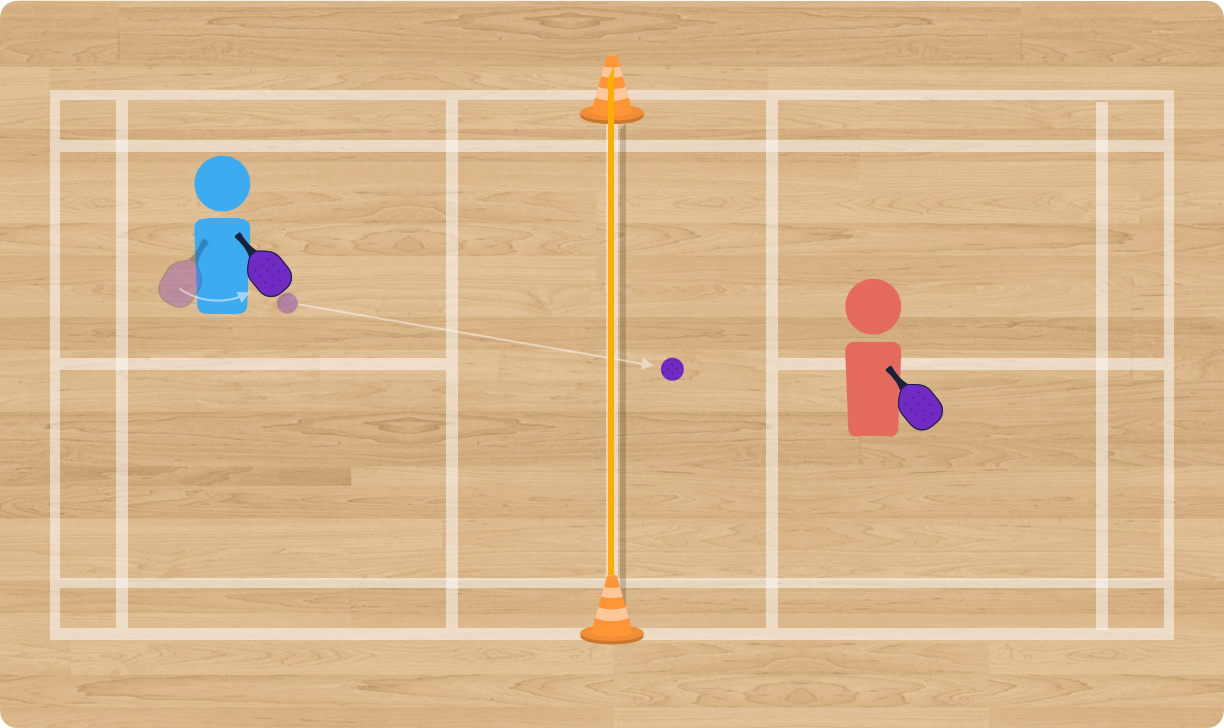
Floor Tennis is a net and wall game played with racquets and a ball that stays on the floor. Players rally under a raised tape net and score by rolling the ball across their opponent's back line, learning to attack the open space along the way.
Hand this to a sub and walk away. Printable pages for every build, diagrams, discussion questions, teacher notes, and assessment ideas. All in one ready-to-print package so there's no sub plan to write.
#PhysEdU Plus includes instant access to every printable game sheet in ThePhysicalEducator.com's games database. $49 a year.
Builds allow you to increase the game's complexity, one layer at a time.
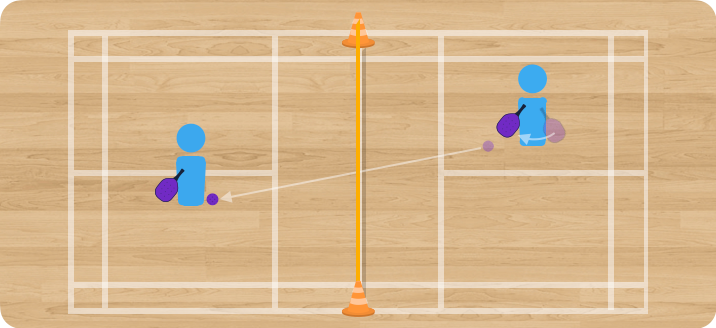
Partners stand on their own half of the court, behind the service line, and work together rather than against each other. Using their racquets, they strike the ball back and forth under the tape and count how many times they can send and receive it without the ball stopping or lifting off the floor.
Encourage partners to place the ball right to each other to begin with so the rally stays alive, then to gradually roll it a little wider once they are comfortable.
Keep this build cooperative so that everyone gets plenty of contacts before competition is introduced. This is also the moment to match the equipment to your group, since a slower ball or larger racquet will keep the rallies going and build confidence.
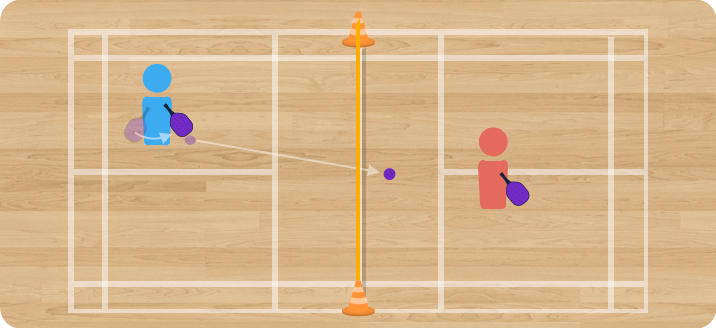
Partners now become opponents.
Everything from Build One still applies, but players are now trying to beat each other. A point is scored when the ball rolls all the way across the opponent's back boundary line.
If a player sends the ball out of bounds, lets it lift off the floor, or fails to reach their opponent's court, the point goes to the other player.
Play to a set number of points, then rotate.
Watch for pairs who remain stationary in the middle of their court and send the ball back and forth. Prompt them to notice where their opponent is standing and whether there is space on either side of them.
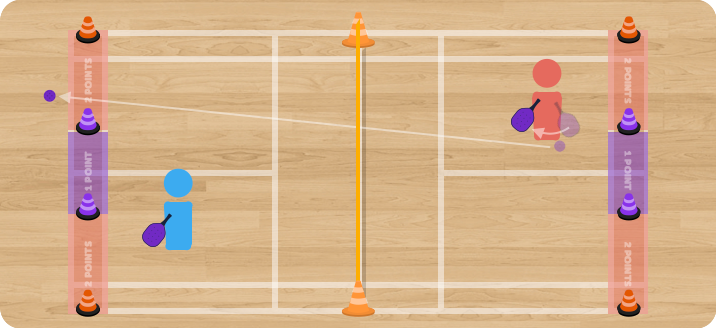
Set up three target gates on each back boundary line using four cones: one in each corner, and two more spaced evenly to divide the line into three equal sections (i.e. a left third, a centre third, and a right third).
Scoring now depends on where the ball crosses the line. A ball that rolls across the centre third is worth 1 point, and a ball that rolls across the left or right third is worth 2 points.
Because the outside thirds are worth more, players are rewarded for getting their opponent moving and then attacking the space they leave behind.
This build is the heart of the game. The weighted scoring does the teaching for you, since players quickly learn that pulling their opponent to one side opens up the far corner.
If a matchup becomes lopsided, you can widen the stronger player's 2 point gates or narrow the developing player's ones to even things out.
Print the game sheet, leave it on your desk, and your sub has everything they need: the diagrams, the builds in order, what to say, and what to watch for. This one is $4. #PhysEdU Plus members get all 39, free forever, for $49 a year.
Games that build on the same tactics.


