

Ships Ahoy is a fundamental movement skills game where the gym becomes a ship and the teacher becomes the captain. Students run, freeze, and crew up on command, getting dozens of reps at tuned-in listening without ever being told to sit still and listen.

Directional calls send the whole class toward the same wall at the same time, so establish a heads up, eyes up rule before your first call and reinforce it between rounds.
Barnacles sends students to a wall at speed. Only call it when students have enough room to slow down before they arrive.
Hit The Deck and Kraken put students on the floor while others are still moving, so make sure the crew knows to look before they drop.
Pick your bow before students arrive and keep it in the same place all year. Once the ship is oriented, port and starboard stop being a guessing game and start being a memory.
I introduce the actions in alternating levels. Hit The Deck is on the floor, Lighthouse is standing, Kraken is on the floor, Crow's Nest is standing. It keeps the kids moving and gets them back on their feet before they are off running again.
There is no elimination in this game. Nobody gets sent to the brig for missing a call. The whole point is reps, and reps disappear the moment you start removing kids. A missed call is a Not Yet, not a strike.
Mutiny is worth saving for last. It gets a big laugh and it is a great note to end a round on.
Hand this to a sub and walk away. Printable pages for every build, diagrams, discussion questions, teacher notes, and assessment ideas. All in one ready-to-print package so there's no sub plan to write.
#PhysEdU Plus includes instant access to every printable game sheet in ThePhysicalEducator.com's games database. $49 a year.
Builds allow you to increase the game's complexity, one layer at a time.
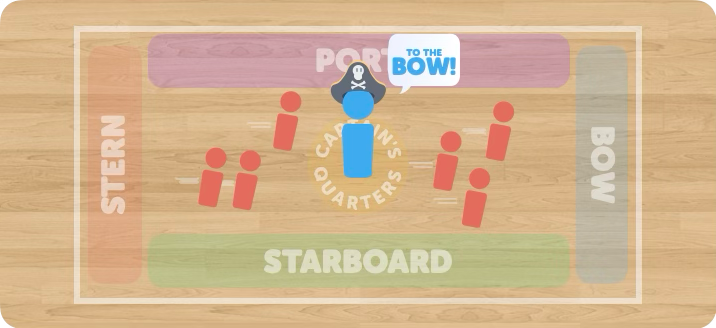
Introduce one location at a time.
Start with the bow. Tell the crew which way the ship is sailing and that the front of the ship is called the bow. Call "To the bow!" and send them there, then bring them back with "Captain's quarters!".
Add the stern, then mix the two. Add starboard, then mix all three. Add port, then mix all four.
Once every location is in the mix, keep calling them in an unpredictable order so students cannot guess what is coming next.
Resist mixing calls too early. Students need a couple of clean reps of each location before it becomes useful in the mix.
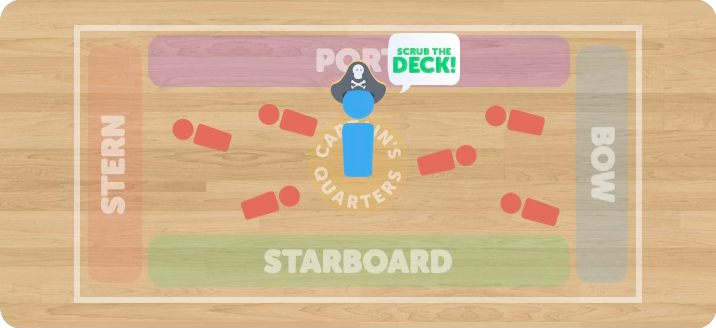
Before this build, teach tuned-in listening: tune in, take in, check in.
Then introduce the individual action cards one at a time, the same way you introduced the locations. "Everybody tune in. Take it in. Here's our first action."
The mix now includes both locations and actions, so students have to hear the call before they can decide whether to run or drop.
I introduce the actions in alternating levels. Hit The Deck is performed on the floor, Lighthouse is performed standing up, Kraken is on the floor, Crow's Nest is standing up. It keeps the kids moving and gets them back on their feet before they are off running again.
The action cards also double as your intensity dial. Hit The Deck and Cannonball bring the energy down. Kraken and Climb The Rigging bring it up.
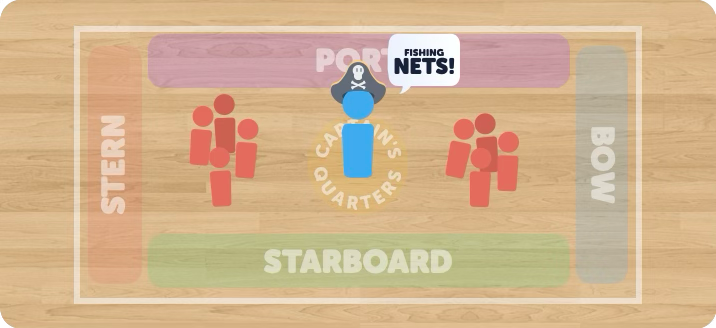
Introduce the group action cards.
These calls require students to find a set number of partners before they can perform the action, which means the listening now has a deadline attached to it.
Keep the locations and individual actions in the mix so students never know whether the next call will send them running, drop them to the floor, or send them looking for a crew.
Finding partners is a social skill as much as a listening one, so have a plan for the student who ends up without a crew. "If you can't find a crew, raise your hand and a crew will wave you over" works well and puts the responsibility on the group instead of the individual.
Mutiny is worth saving for last. It gets a big laugh and it is a great note to end a round on.
Print the game sheet, leave it on your desk, and your sub has everything they need: the diagrams, the builds in order, what to say, and what to watch for. This one is $4. #PhysEdU Plus members get all 39, free forever, for $49 a year.
Games that build on the same tactics.


