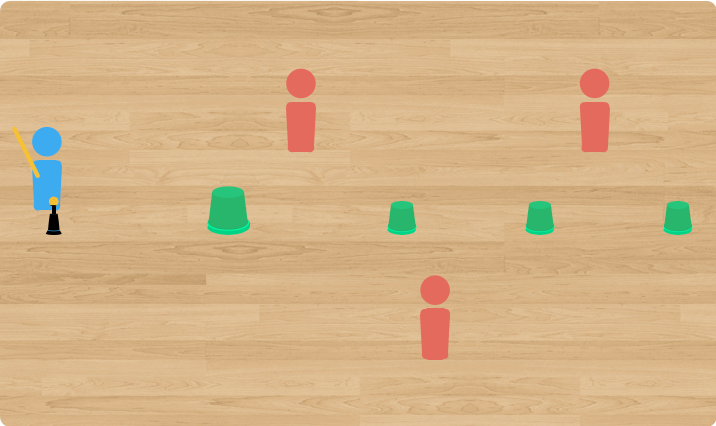
Two teams face off in an epic striking and fielding game. Batting team players attempt to run around the loop of multiple bases to score points. Fielding team players slow the running players down by fielding the ball to a Stop Spot, instantly freezing all running players.
Have students drop (not throw) the bat after batting
Allow students from the batting team to pass each other when running around the bases.
Fielding team players should never get in a running player’s way.
Builds allow you to increase the game's complexity, one layer at a time.
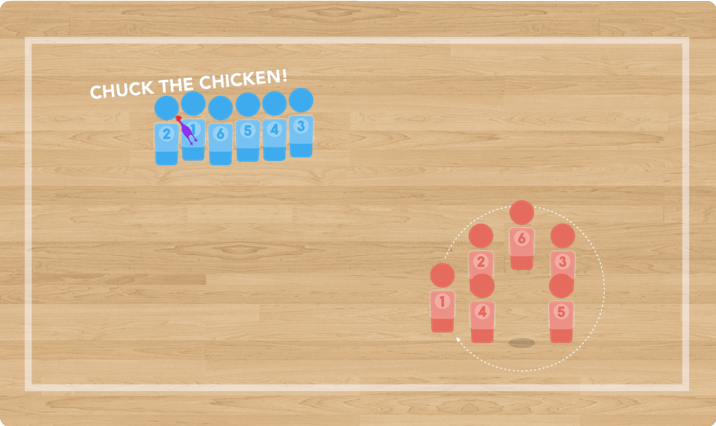
The batting team lines up behind the catcher's base. Each player on the fielding team stands on a fielding base so that all bases are covered. The first batting player steps onto Home Plate and the catcher is given the ball.
On the teacher's signal, the batting player runs clockwise around the bases, touching each one. At the same time, the fielding team relays the ball clockwise around their bases, starting from the catcher's base. Fielding players must be on their base before relaying to the next.
The batting player tries to get back home before the ball completes its loop back to the catcher's base. Whoever gets there first earns a point for their team.
Between turns, fielding players all switch bases. Once every batting player has run, the teams switch roles.
Switching fielding bases between every turn is worth enforcing. It stops the same student from owning the same base all lesson and gives everyone a feel for the different distances.
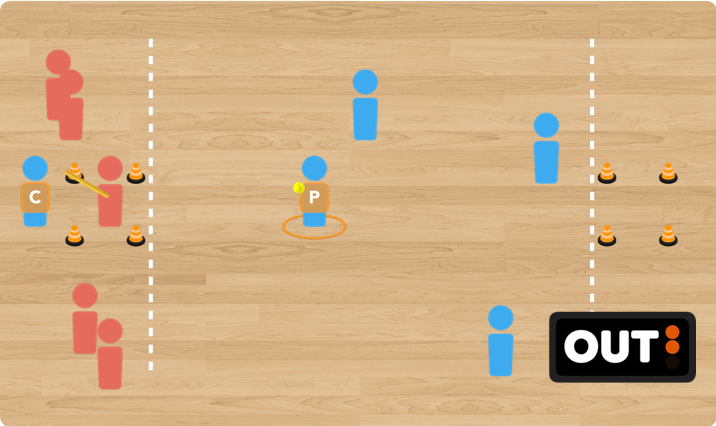
The batting team sets their batting order and waits in their dugout area off to the side of the base circles. The teacher selects three fielding bases which, along with the catcher's base, are assigned as Stop Spots. The fielding team sets up on their bases.
The first batting player steps up to Home Plate with the ball in their hand and throws it so that it lands within the bases. As soon as they throw, they begin making their way around the bases.
To stop the run, the fielding team must field the ball to one of the Stop Spots. Once the player at that Stop Spot has the ball while on their base, they call "STOP" and every running player returns to the last base they touched.
After each stop, the fielding team rotates clockwise and the next batting player steps up. Once they throw, all batting players on base begin running again.
A ball thrown outside the base circles is a foul. The batting player throws again, but only after all batting players have returned to the base they were on before the throw. Multiple batting players may occupy the same base.
A batting player who makes it around and touches Home Plate scores a point. Once every batting player has had a turn, the teams switch roles.
The teacher creates a foul line that runs tangent to the base circles at Home Plate.
Play continues with the same rules, except that batting players must now strike the ball with a bat to put it into play. The ball is pitched by the next player in their team's batting order, and must land beyond the foul line to be considered in play.
As in the previous build, batting players score by making their way around the bases while fielding players work to field the ball to a Stop Spot.
Once every batting player has had a turn at bat, the teams switch roles.
This final build is optional and is best taken outside.
Decrease the number of bases and increase the playing area so that it covers a huge space. All fielding bases now count as Stop Spots. The fielding team decides who plays on base and who spreads out across the field.
The fun here is placing bases in creative spots depending on where you are playing. Batting players have much further to run between bases, but also far more open space to work with.
As in the previous build, batting players score by making their way around the bases while fielding players work to field the ball to a Stop Spot. Once every batting player has had a turn at bat, the teams switch roles.
Genuinely optional, and a good one to hold for a warm day or a field trip. The scale of the space is the whole point, so do not try to squeeze it into the gym.
Print the game sheet, leave it on your desk, and your sub has everything they need: the diagrams, the builds in order, what to say, and what to watch for. This one is $4. #PhysEdU Plus members get all 39, free forever, for $49 a year.
Games that build on the same tactics.