Ribby is a striking and fielding game for physical education in which students must make a tough decision: do you go for one point by running to first base, or do you push for two points by running to second? The catch: once you pass first, there's no turning back!
Students at bat should make sure that they do not throw the bat after having struck the ball.
Fielding players at base should not prevent the batting players from running.
The catcher should play a safe distance away from home base.
Hand this to a sub and walk away. Printable pages for every build, diagrams, discussion questions, teacher notes, and assessment ideas. All in one ready-to-print package so there's no sub plan to write.
#PhysEdU Plus includes instant access to every printable game sheet in ThePhysicalEducator.com's games database. $49 a year.
Builds allow you to increase the game's complexity, one layer at a time.
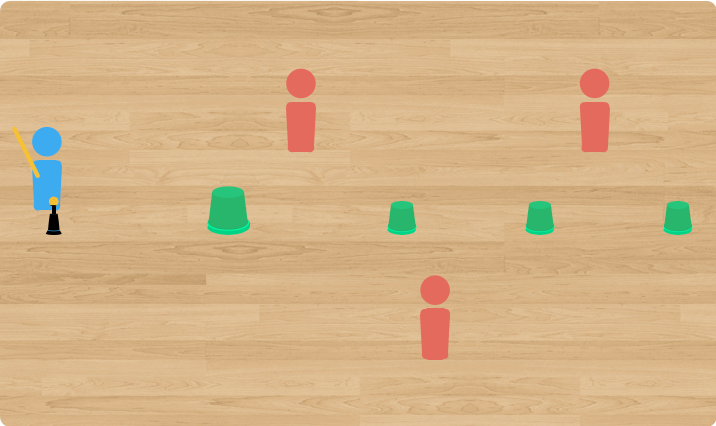
The teacher sets up the playing area by placing hoops or similar base markers for home, first base, and second base. Where third base would be, the teacher places a cone instead.
Students all line up behind the cone at third base. The first player in line moves to home base. On the teacher's signal, that player takes off and runs to first, then second, and then back to the end of the line.
As soon as the player takes off, the next player in line moves to home base, where they wait until the first runner reaches second base. That is their cue to take off to first base.
Players keep running in this cycle until each player has had a turn running the bases three times.
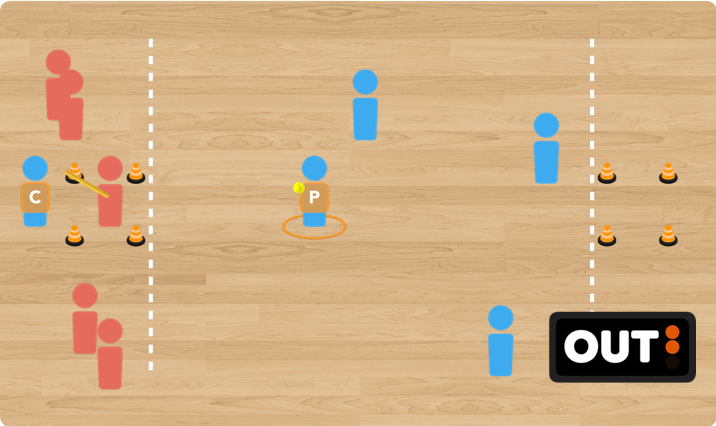
The teacher divides the class into two teams, one batting and one fielding. Second base is removed for this build and a bat is placed at home base.
The fielding team designates one player as the first baseman. They switch who plays first base after every other at bat, ensuring all fielding players get a turn there before anyone gets a second.
The batting team lines up behind the cone and sends their first player to home base. The teacher can pitch, or select a player from the fielding team to do it. Either way, the pitcher's job in this build is to set the batting player up for success by pitching so that the ball is likely to be struck.
Players cannot strike out or be caught out in this build. The only way to get the batting player out is to field the ball to first base before they get there.
As soon as the batting player strikes the ball into play, they run to first base as fast as they can. If they beat the ball there, they score a point for their team. If the ball beats them, no point is scored. Either way, the batting player returns to the end of their team's line behind the cone.
Once all players on the batting team have batted, the teams switch roles.
The teacher returns the second base marker to the playing area. The fielding team now assigns players to both first base and second base.
Play continues as before, except the batting player now has two choices. They can run to first for a single point, or attempt to run past first and on to second base for two points.
If the batting player decides to run to second, they cannot move back to first. It is two points or nothing. After the play is dead, the batting player returns to the end of their team's line at the cone.
The fielding team now has to read and react to the batting player's actions, looking for cues to decide whether to field the ball to first base or second. If the ball beats the batting player to the base they are running to, the fielding team denies the point.
Teams switch roles once every player on the batting team has had a turn at bat.
Between switchovers, talk with students about the cues that influence their defensive decisions. Keeping track of their ideas on a whiteboard works well.
This build adds complexity to really push students' decision making.
The pitcher delivers the ball as in previous builds, but players can now strike out after three strikes. Batting players can also be caught out if a fielding player catches the ball straight out of the air off their hit. As before, a batting player is out if they fail to reach a base before the fielding team fields the ball there.
The batting player can now choose to stop at first and remain there. They still score a point for reaching first, and can attempt a second point by running to second during the next at bat. However, a player who stays at first is forced to run to second when the next batting player hits the ball into play. This is a good moment to teach forced run situations.
The fielding team must now read the game and decide which defensive play is best for the current situation. They also have the option of completing a double play by fielding the ball to both bases before the batting team players reach them.
The fielding team can now cause a switchover in three ways: once each player on the batting team has had a turn at bat, once the fielding team has got three players out, or if the fielding team completes a double play.
The game runs for a set number of innings or until a team reaches a predetermined score.
Print the game sheet, leave it on your desk, and your sub has everything they need: the diagrams, the builds in order, what to say, and what to watch for. This one is $4. #PhysEdU Plus members get all 39, free forever, for $49 a year.
Games that build on the same tactics.