Health & Fitness

Portals

Portals is a health and fitness game in which students hold hula hoops upright to build gateways that runners must leap through in a race to grab the key. Expect quick reactions, all-out sprints, and hearts pounding fast.
Learning Targets

I can give my best effort during short bursts of fast movement.
I know the signs that tell me my body is working hard.
I understand how my heart helps me when I move at top speed.

Game Overview

Play Area

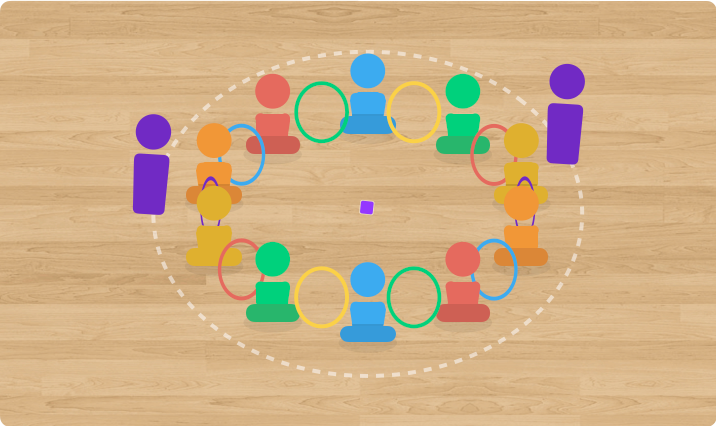
Divide your class into six teams, one per rainbow colour.

Students sit in a large circle in the centre of the playing area, in a rainbow pattern.

A hula hoop is placed on the floor between each pair of students, and the hoops follow the same rainbow pattern around the circle.

Leave a clear running lane around the outside of the circle.

Goal

Be the first runner to travel through a portal and grab the key from the middle of the circle.

Play
  • Seated students work with their neighbours to hold the hoop between them upright. These hoops are the portals.
  • The teacher places a beanbag in the middle of the circle. This is the key.
  • One group is selected as the runners. Their hoops are removed from the game and the gaps in the circle are closed.
  • Runners stand outside the circle and begin jogging around it in a counterclockwise direction.
  • At a random moment, the teacher calls out "GET THE KEY!"
  • On that call, each runner must hop through the closest portal, race to the middle of the circle, and try to be the first to grab the key.
  • A new group of runners is then selected and a new round begins.

Equipment

  • Hula hoops in six colours
  • Beanbags

Assessment Ideas

  • Heart Check-Ins can be used to assess whether students can recognize and name the signs that their body is working hard.
  • An Effort Observation Tool can be used to assess how consistently students give their best effort during their turns as runners.
  • Exit Tickets can be used to assess whether students can explain what their heart does when they move quickly.

Safety

Students hold the hoops with a loose grip and let go if a runner catches the hoop while passing through.

Seated students keep their legs crossed and tucked in to keep the running lane clear.

Runners keep their heads up and their eyes forward, especially as they converge on the key in the middle of the circle.

Teach students to grab the key and lift it rather than pulling on it.

Teacher Notes

At the key, teach "grab and hold it up" instead of "grab and pull." If two hands land at the same time, celebrate both.

Printable Game Sheet

Hand this to a sub and walk away. Printable pages for every build, diagrams,  discussion questions, teacher notes, and assessment ideas. All in one ready-to-print package so there's no sub plan to write.

$4
USD · instant download
Add to cart
OR NEVER PAY FOR ONE AGAIN

#PhysEdU Plus includes instant access to every printable game sheet in ThePhysicalEducator.com's games database. $49 a year.

See what's in Plus

Game Builds

Builds allow you to increase the game's complexity, one layer at a time.
1
Build
1

Runners

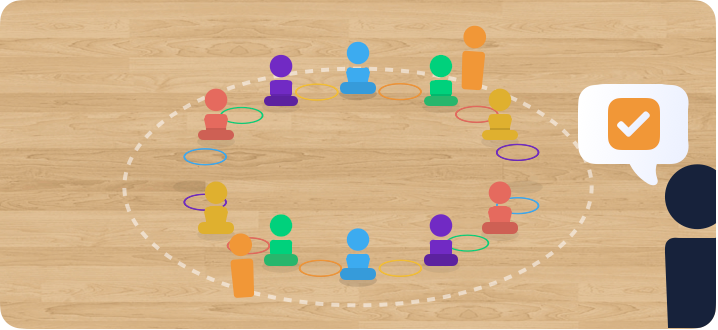
Students sit in the circle in their rainbow groups with the hoops resting flat on the floor between them. No portals and no key yet.

The teacher calls out a colour. The students in that colour group get up quickly, race around the outside of the circle in a counterclockwise direction, and try to get back to their spot before the rest of their group.

Discussion Questions

  • What did your body feel like right after your run?
  • How did your breathing change from the start of the game to the end?
  • Why is it important that everyone runs in the same direction?

Teacher Notes

This build serves as your warm-up, teaches the formation, and locks in the running direction before anything else gets added.

Call the colours in an unpredictable order and call some groups twice. Students should never be able to guess when their turn is coming, which keeps everyone alert and ready.
2
Build
2

Portals

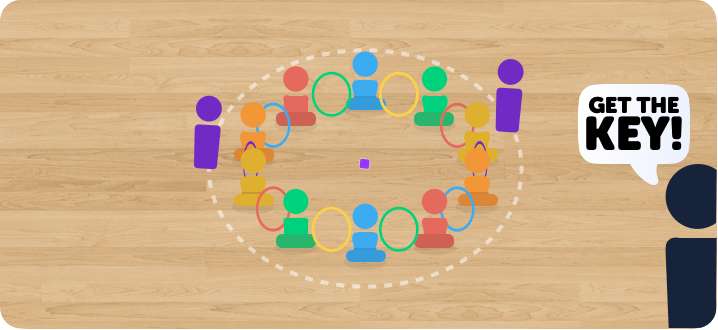
Add the key to the middle of the circle and have students lift the hoops upright to create the portals. One colour group starts as the runners, with their hoops removed and the gaps closed.

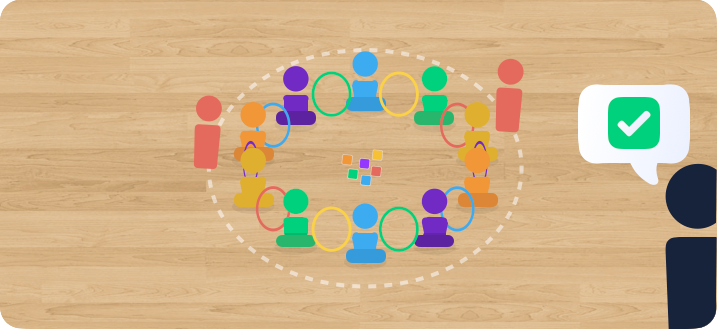
Runners jog around the outside of the circle. When the teacher calls "GET THE KEY!", each runner hops through the nearest portal, races to the middle, and tries to grab the key first. A new group becomes the runners and the next round begins.
Discussion Questions

  • Where in your body could you feel your heart beating after that round?
  • What made it tricky to be the first one to the key?
  • How did the portal holders help keep the game safe and fun?

Assessment Ideas

  • An Effort Observation Tool can be used to assess how consistently students accelerate on the call rather than waiting to see what others do.
3
Build
3

Rainbow Portals

Same setup as Build Two, except now there are six keys in the middle of the circle, one in each colour of the rainbow.

The teacher now calls "GET THE [COLOUR] KEY!", naming one specific colour.

Runners must continue in the direction they are already travelling, find the closest portal of that colour without turning around, hop through it, and grab the key of that colour.

Discussion Questions

  • How did you decide which portal to head for?
  • What happened to your speed when you had to think and run at the same time?
  • Did this round feel harder on your body than the last one? What tells you that?

Assessment Ideas

  • Exit Tickets can be used to assess whether students can name one sign their body gave them that it was working hard.
  • Self-Assessment Checklists can be used to assess whether students can rate the effort they gave across the three builds.

Teacher Notes

The no-turning-around rule is the whole point of this build. It forces students to scan ahead and commit, which means a runner who has just passed the purple portal has to cover almost a full lap to get back to it.

Away on Thursday?

Print the game sheet, leave it on your desk, and your sub has everything they need: the diagrams, the builds in order, what to say, and what to watch for. This one is $4. #PhysEdU Plus members get all 39, free forever, for $49 a year.

More
Health & Fitness
Games

Games that build on the same tactics.