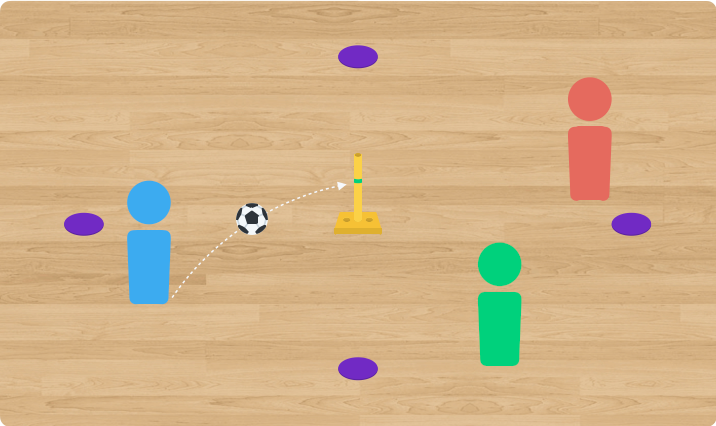
B-O-W-L is a fun target game that you can play at home. Challenge a friend or family member in a battle of your best bowling shots as you develop your ability to select appropriate shots in different game situations!
Students must bowl the ball along the floor and not throw it.
Players must never run across a playing area.
The game should be played with a ball that is appropriate for the playing area (i.e. that won’t damage the floor)
Hand this to a sub and walk away. Printable pages for every build, diagrams, discussion questions, teacher notes, and assessment ideas. All in one ready-to-print package so there's no sub plan to write.
#PhysEdU Plus includes instant access to every printable game sheet in ThePhysicalEducator.com's games database. $49 a year.
Builds allow you to increase the game's complexity, one layer at a time.
Students set up their pin markers in a one-two-three triangular formation, numbering them from one to six. Markers within a row should sit about 4.5 inches apart, with about 9 inches between markers one and five. A foul line is then set roughly ten feet from the headpin.
Ideally, six identical bowling pins are set on the markers. Where bowling pins are not available, empty rolls, markers, or water bottles all work.
Standing behind the foul line, students bowl the ball and try to knock over all of the pins, removing any knocked-over pins after each attempt and counting how many attempts it takes to clear the set.
The measurements matter more than they look, since the challenge cards in Build Two assume this spacing. Getting the setup right once saves resetting it for every card.
The teacher provides each pair with the B-O-W-L Challenge Cards. Where printing is not possible, a deck of playing cards works instead: pull the two, three, and four from each suit and use the Challenge Cards PDF as the reference key, since each card in the document is assigned a playing card.
Players shuffle the deck and pick a card. Their challenge is to set up the pins as shown on that card and keep bowling until they knock over all of those pins in a single attempt.
Once they have done so, they pick the next card and keep going.
This is the build where the understanding target gets its reps. Each formation asks a different question about where to aim, so give students enough time to work through several cards.
Partners play rock, paper, scissors to decide who starts as the lead bowler.
The lead bowler draws a Challenge Card and their partner sets up the pins in the formation shown. Once the pins are set, the lead bowler shuffles the card back into the deck.
The lead bowler has three attempts to knock over all of the pins in a single bowl. If they miss, or get a spare, their partner resets the pins and returns the ball after each attempt.
If the lead bowler succeeds, their opponent then has three attempts to do the same. If the opponent matches it, the lead bowler picks a new card and the process repeats. If the opponent fails, they earn a B, and it remains the lead bowler's turn to pick a card and bowl.
If the lead bowler fails to knock over the pins, their opponent becomes the lead and draws a new card.
Play continues until one player earns all four letters of the word BOWL, at which point their opponent wins the round.
Print the game sheet, leave it on your desk, and your sub has everything they need: the diagrams, the builds in order, what to say, and what to watch for. This one is $4. #PhysEdU Plus members get all 39, free forever, for $49 a year.
Games that build on the same tactics.