Health & Fitness

Hospital Tag

Hospital Tag is a health and fitness game in which taggers put players out of action while first aiders race to get them back in. Students learn to tell minor injuries from major ones and why knowing their personal information matters in an emergency.
Learning Targets

I can tell the difference between a minor injury and a major injury.
I know examples of minor and major injuries.
I understand why knowing my personal information matters when I need help.

Game Overview

Play Area

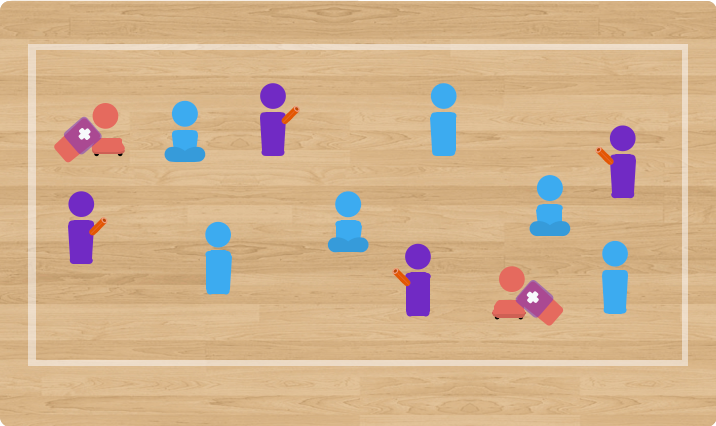
Set up a large open boundary. Place a clearly marked hospital zone on one side, staffed by the teacher. All other students begin inside the boundary.

Goal

Taggers try to put players out of action. First aiders work to get injured players back in the game as quickly as possible.

Play
  • Taggers move through the space and tag players with a foam pool noodle.
  • First tag: the tagged player holds the spot they were tagged and keeps playing with their free hand.
  • Second tag: the player holds both tagged spots and sits down. They are now injured.
  • First aiders watch for sitting players. When they spot one, they wheel their scooter cart over to them.
  • The first aider rolls the pocket dice. Together, the first aider and injured player determine whether this is a minor injury or a major injury.
  • Minor injury: the first aider pretends to treat the injury, wrapping a bandage or applying pressure. The player gets back in the game.
  • Major injury: the first aider loads the player onto the scooter cart and wheels them to the hospital, staffed by the teacher.
  • At the hospital, the player shares one piece of personal information to be cleared to return to the game.

Equipment

  • Foam pool noodles
  • Scooter carts
  • Pinnies
  • Pocket dice (one per first aider, six faces: three minor injuries, three major injuries)

Assessment Ideas

  • Exit Tickets can be used to assess whether students can correctly identify examples of minor and major injuries.
  • Observation Tools can be used to assess whether students are able to apply the minor versus major distinction during first aider interactions.
  • Self-Assessment Checklists can be used to assess whether students can name at least one piece of personal information they would share with a trusted adult in an emergency.

Safety

  • Taggers should use gentle, controlled noodle tags below the shoulders. No swinging near the head and no winding up.
  • Players riding a scooter cart keep their hands in their lap and away from the wheels. Long hair should be tied back before play begins.
  • First aiders walk when transporting an injured player. A seated passenger cannot brace themselves, so speed is the main risk in this game.
  • Everyone should keep their heads up and be aware of seated players on the floor.

Printable Game Sheet

Hand this to a sub and walk away. Printable pages for every build, diagrams,  discussion questions, teacher notes, and assessment ideas. All in one ready-to-print package so there's no sub plan to write.

$4
USD · instant download
Add to cart
OR NEVER PAY FOR ONE AGAIN

#PhysEdU Plus includes instant access to every printable game sheet in ThePhysicalEducator.com's games database. $49 a year.

See what's in Plus

Game Builds

Builds allow you to increase the game's complexity, one layer at a time.
1
Build
1

Hospital Tag

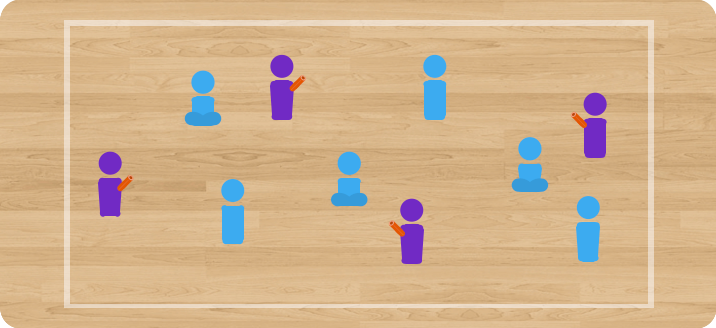
Students play a simple tag game. Taggers use foam pool noodles. When tagged, fleeing players must perform the following actions.

First tag: hold the spot where they were tagged and keep playing.

Second tag: sit down.

There is no way back into the game yet. The teacher stops play periodically to discuss what students noticed.

Discussion Questions

  • What happened when you got tagged a second time? How did that feel?
  • In real life, if someone got hurt and couldn't keep going, what do you think should happen?

Teacher Notes

This build is intentionally simple. The goal is to get students moving, establish the tagging rules, and create a shared experience of being injured that you can connect to the health concepts in the next builds. Keep it short, five to seven minutes, and debrief before moving on.
2
Build
2

First Aiders (Minor Injuries)

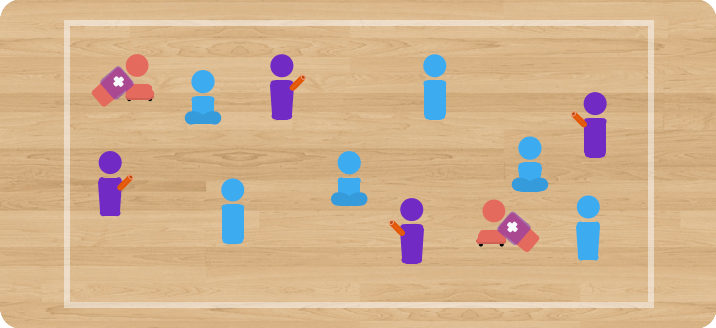
The teacher selects two or three students to be first aiders. First aiders do not get tagged.

When a player sits down, a first aider wheels their scooter cart to them and pretends to provide first aid. Once first aid is complete, the player is back in the game.

Introduce the concept: first aid is about helping someone who is hurt so they can be okay.
Discussion Questions

  • What did the first aider do to help you? What does "first aid" mean to you?
  • Does first aid fix the injury completely, or does it just help someone feel better enough to keep going?

Assessment Ideas

  • Exit Tickets can be used to assess whether students can explain in their own words what first aid means.
3
Build
3

Injury Dice

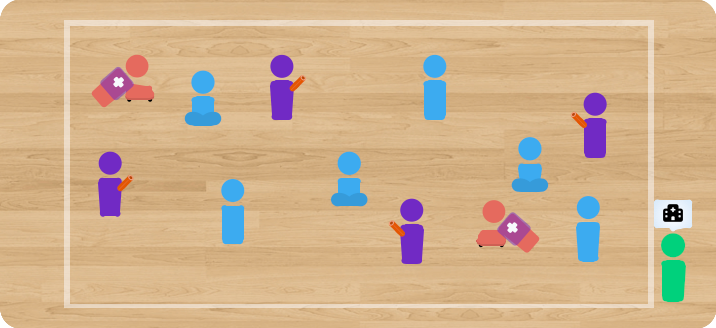
Full version of the game. First aiders now carry pocket dice. When they reach a sitting player, they roll the dice together and determine whether the injury is minor or major.

Minor injuries are treated on the spot and the player returns to the game. Major injuries require the first aider to wheel the player to the hospital, staffed by the teacher.

At the hospital, the player shares one piece of personal information, such as their full name, home address, parent or guardian name, or home phone number, to get cleared.

Discussion Questions

  • What is the difference between a minor injury and a major injury? How did you know which was which?
  • Why do you think major injuries need more help than a first aider on their own?
  • What personal information did you share at the hospital? Why do you think that information matters when someone needs help?

Assessment Ideas

  • Observation Tools can be used to assess whether students are correctly applying the minor versus major distinction during first aider interactions.
  • Exit Tickets can be used to assess whether students can name at least one piece of personal information and explain why it matters in an emergency.

Teacher Notes

The pocket dice should have three faces labelled as minor injuries (bump, bruise, scrape) and three faces labelled as major injuries (head injury, broken bone, major cut). If pocket dice are not available, use regular dice with a reference card where one to three is minor and four to six is major.

The hospital conversation is the most important teaching moment in this build. Keep it low pressure and conversational. Students just need to share one piece of personal information to get back in, and every correct answer is worth celebrating enthusiastically.

Away on Thursday?

Print the game sheet, leave it on your desk, and your sub has everything they need: the diagrams, the builds in order, what to say, and what to watch for. This one is $4. #PhysEdU Plus members get all 39, free forever, for $49 a year.

More
Health & Fitness
Games

Games that build on the same tactics.