


For the first time in a long time, I just went through the process of planning, organizing, and running a sport education season in my physical education program.
In this post, I want to break down what this looked like, why I decided to go with Sport Education, and how everything panned out.
Let's dive in!
What is Sport Education?
Sport Education (SEM) is a pedagogical model developed by Daryl Siedentop in the early 1980s, designed to provide authentic sport experiences in physical education.
The model was born out of a frustration with the way sport was being taught in PE: short units dominated by isolated skill drills, followed by poorly played games where skilled students dominated and less-skilled students disengaged.
SEM is structured around six defining features that mirror what makes sport meaningful in the real world: seasons (longer than typical PE units), team affiliation (students stay on the same team for the full season), formal competition (a schedule of games that counts), a culminating event (a championship that gives the season its energy), record keeping(standings, statistics, and scores), and festivity (celebrations, team identity, awards).
The model aims to develop three kinds of sportsperson: competent (they can play the game well enough to enjoy it), literate (they understand the rules, traditions, and values of sport), and enthusiastic (they want to keep playing, both in and out of school).
Student roles are central. Students do not just play: they also coach, referee, scorekeeper, and manage. This shifts responsibility from the teacher to the students and teaches them that a sport experience depends on more than just the players on the field.
Why Did I Go With Sport Education?
I am continuing to tinker with my annual curriculum map. While I had planned to do a striking and fielding unit in the spring, I realized that my late spring curriculum for my Grade 2 classes was looking a little packed. That said, I decided to switch things up to pursue the following outcomes with my students:
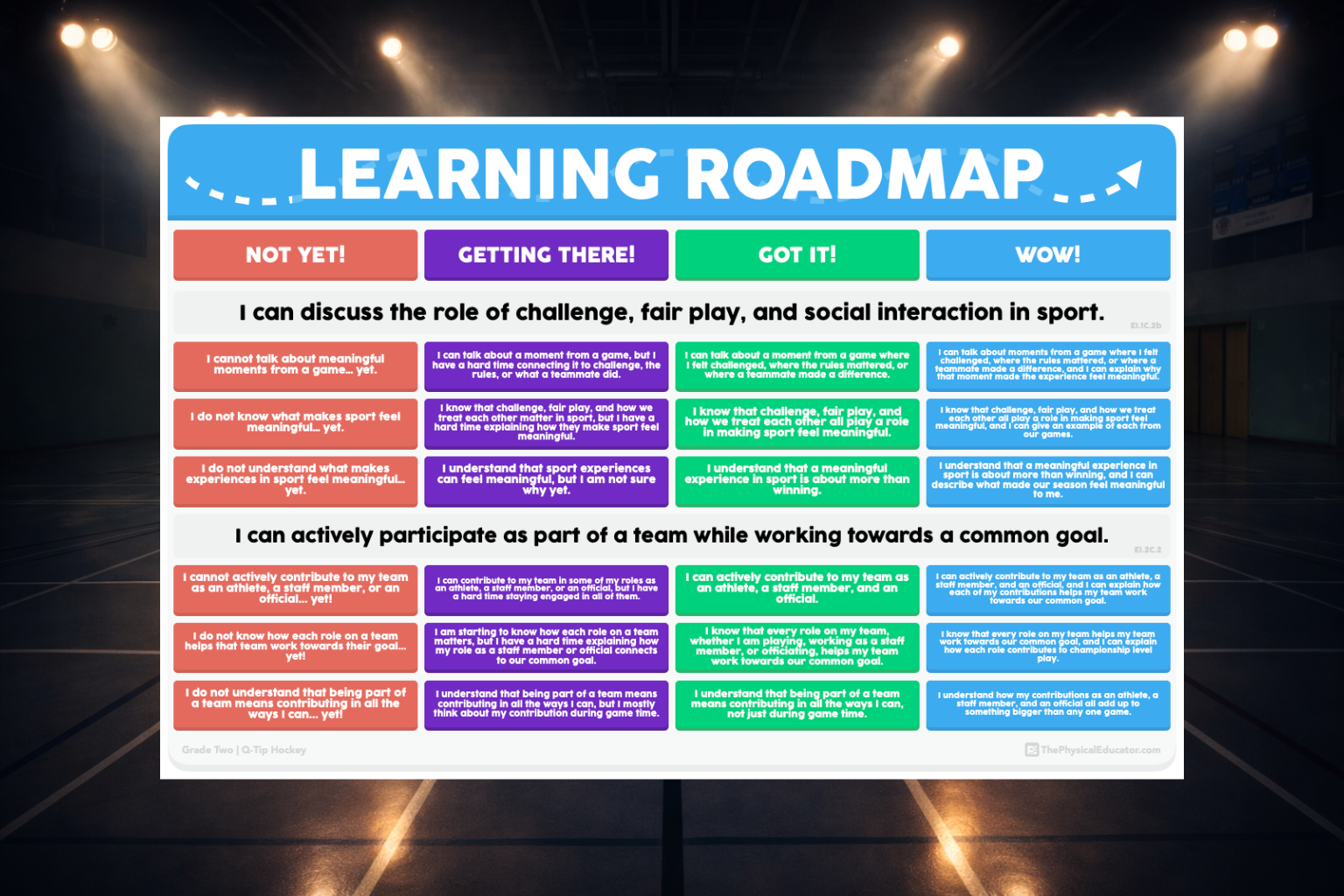
- EI.1C.2b: I can discuss the role of challenge, fair play, and social interaction in sport
- EI.2C.2: I can actively participate as part of a team while working towards a common goal
The outcomes are about finding meaning in sport and contributing to a team beyond just playing. Sport Education was the natural fit because its core features (seasons, affiliation, formal competition, roles, record keeping, festivity, and a culminating event) create the conditions for students to actually experience these ideas rather than just talk about them.
The research backs this up. A 2018 systematic review (Evangelio et al.) confirmed positive outcomes across all four PE learning domains at every grade level, including as early as Grade 2. Studies by Gutiérrez et al. (2014) and Layne & Hastie (2014) specifically documented successful SEM implementation with young learners, with one consistent caveat: more teacher scaffolding, simplified roles, and longer preseasons are essential. The research also consistently shows that SEM improves social skills and fair play, increases intrinsic motivation, and helps students meet their basic psychological needs for autonomy, competence, and relatedness. All of that lined up directly with what I was hoping to achieve with these two outcomes.
Unpacking these outcomes led to the following Learning Roadmap:
With this roadmap made and my decision to go with Sport Education set in stone, all that was left to do was to figure out how to make this work with my younger students.
Adapting SEM for Grade 2
The typical SEM season runs 12 to 20+ lessons. I ended up compressing this to roughly 9 lessons per class (5 preseason + 3 game days + 1 championship day) by running two games per division per lesson.
Games were two 4-minute halves with a 1-minute break. Two games back to back fit cleanly into the 20-minute main block of a 30-minute lesson.
Only four student roles were used: player, coach, referee, and scorekeeper. The Siedentop guide recommends keeping roles simple for first-time users and young learners.
To help students learn these roles, I created the following Q-Tip Role Card visuals:

Rather than assigning roles to students and having students play that specific role for the entire season, I set up a daily rotation schedule so that the kids got to experience every role throughout the season (and multiple times so that they became familiar with each role).
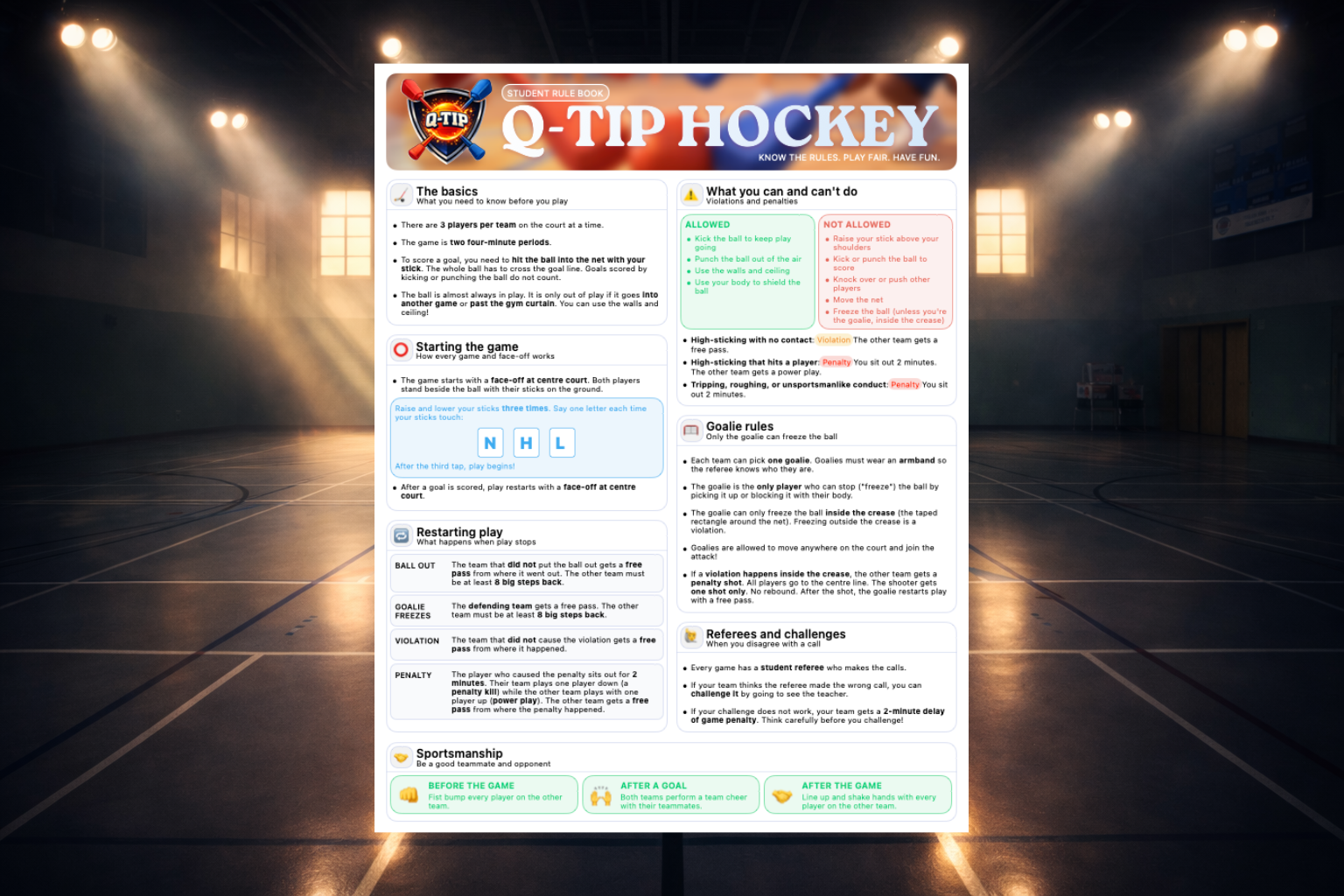
The referee role was scaffolded across the preseason: students started by watching the teacher referee, then co-officiated, then took the whistle themselves. The ruleset was kept minimal (out of bounds, goals, and one or two fouls). I made this Q-Tip Rules one-pager to make sure everyone was on the same page:
Scorekeeping was tally marks only. Two columns, one per team, final score confirmed with the referee. No statistics, no penalty tracking.
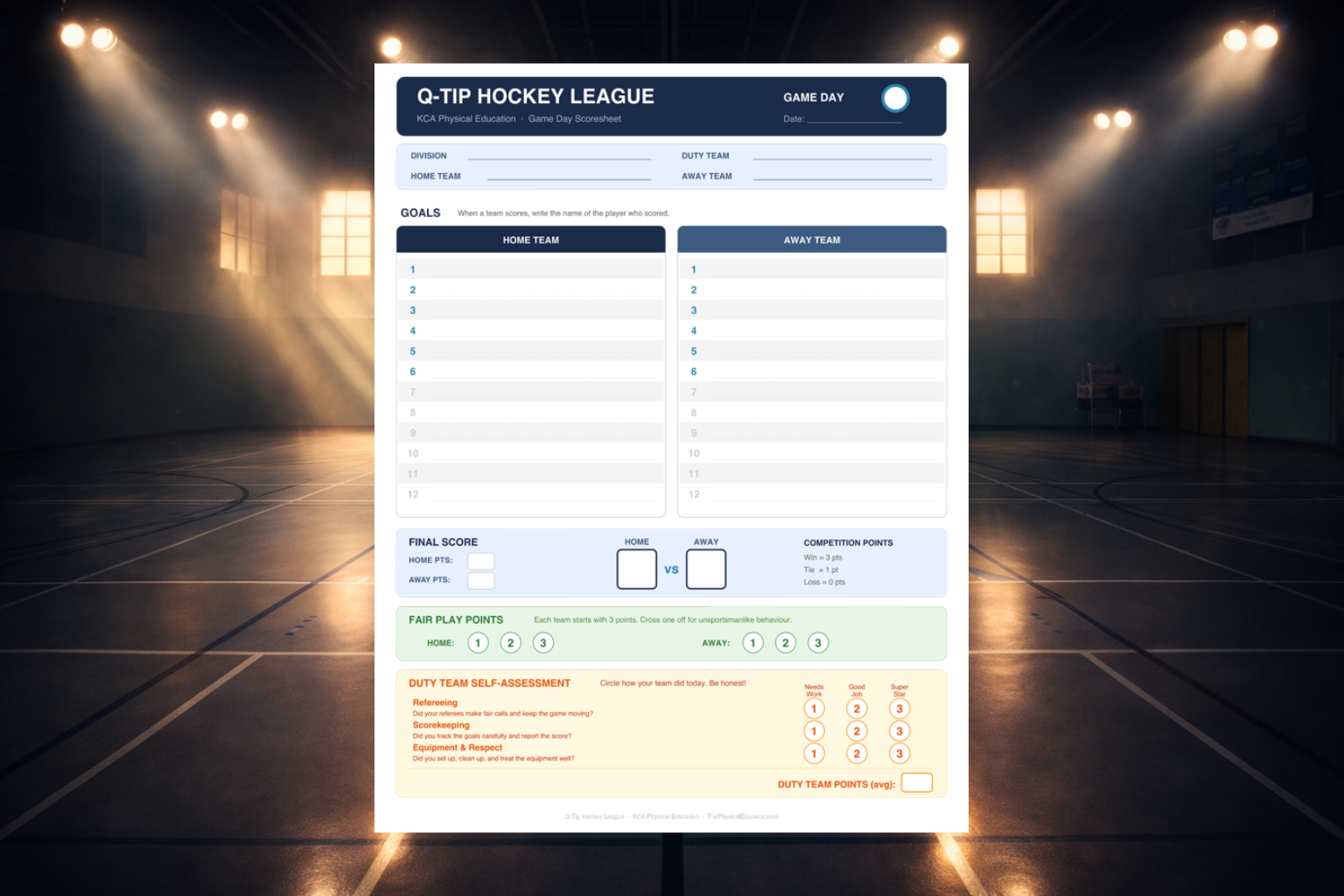
Fair play was built into the championship points system rather than treated as a separate behaviour management tool. Teams started each game day with 3 fair play points that could be deducted for unsportsmanlike behaviour (arguing with the ref, put-downs, not fulfilling duty team responsibilities).
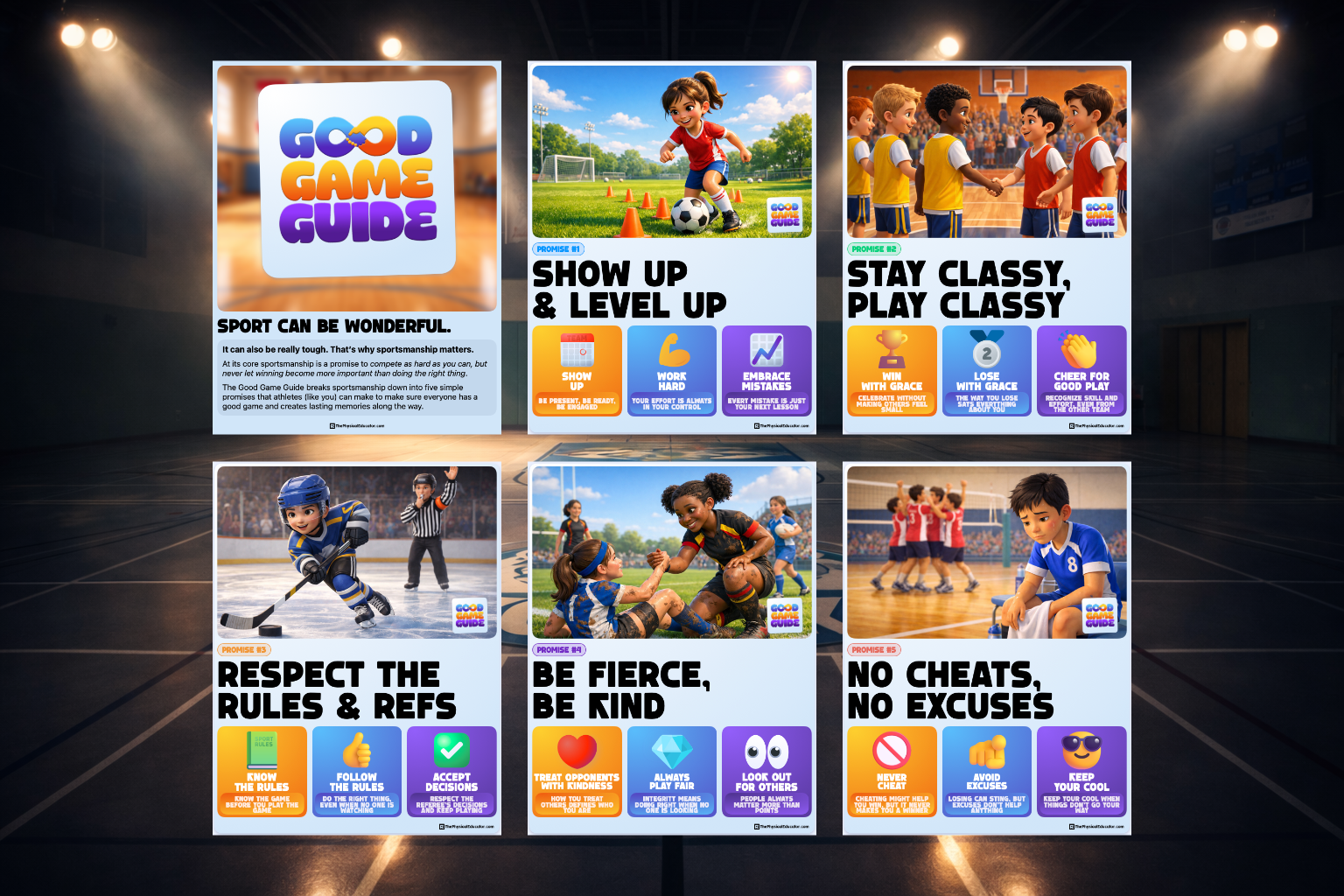
To help students understand what fair play looks like, I created this series of Good Game Guide sportsmanship posters (which you can download here):
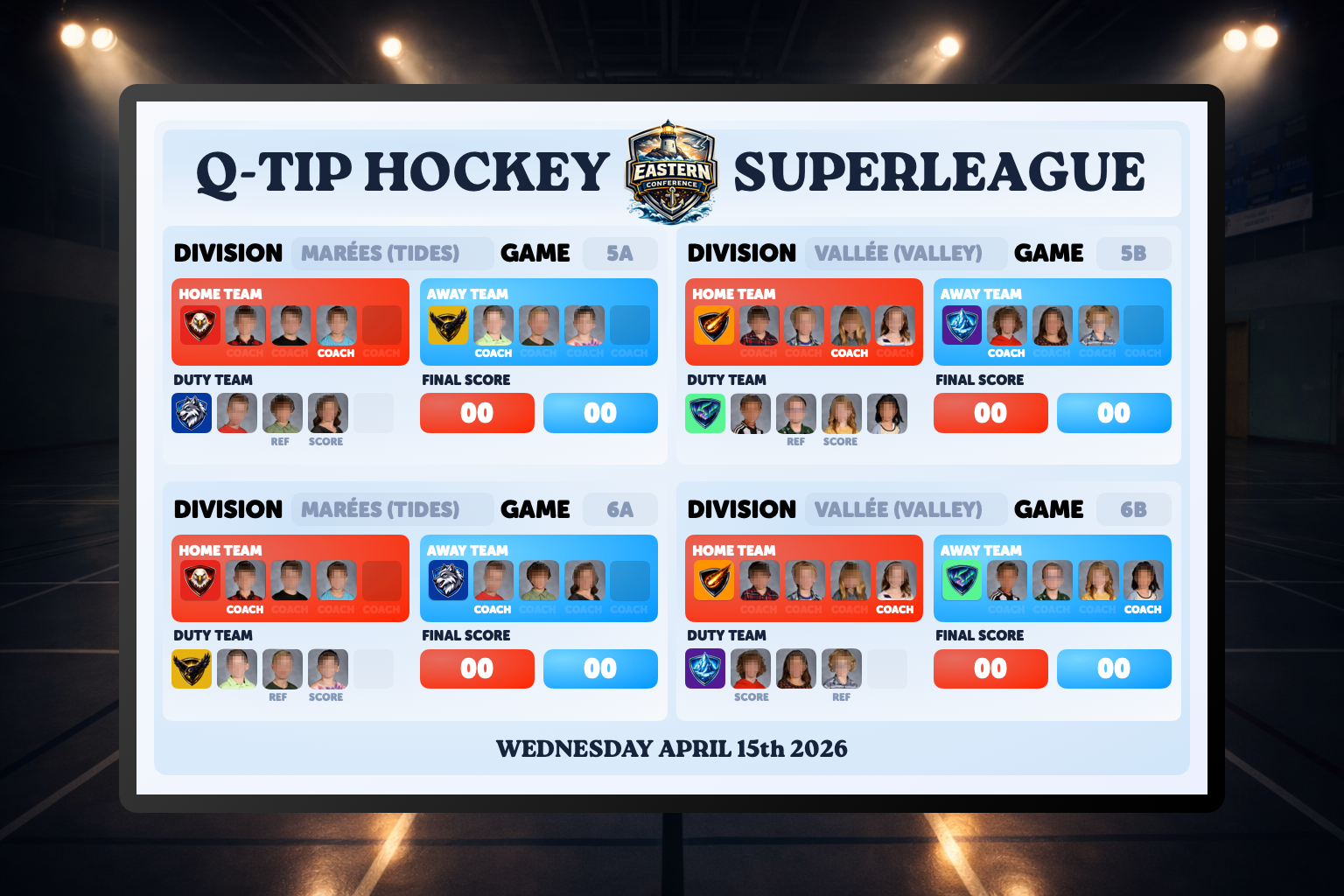
Finally, every lesson followed the same routine: team huddle (3 min), main block (20-22 min), closure reflection (5 min). The consistent structure was essential for 7- and 8-year-olds. To make our team huddle as efficient as possible, I designed this daily game board that would be displayed on our TV so that students could see who was playing, when they were playing, and who was playing each role that day:
How The Season Played Out
I started the unit by informing my students that they were now part of the Q-Tip Hockey Superleague.
Our league would be broken down into two conferences:
- Eastern Conference (French Immersion class, 20 students)
- Western Conference (English class, 21 students)
Each conference had two divisions of three teams:
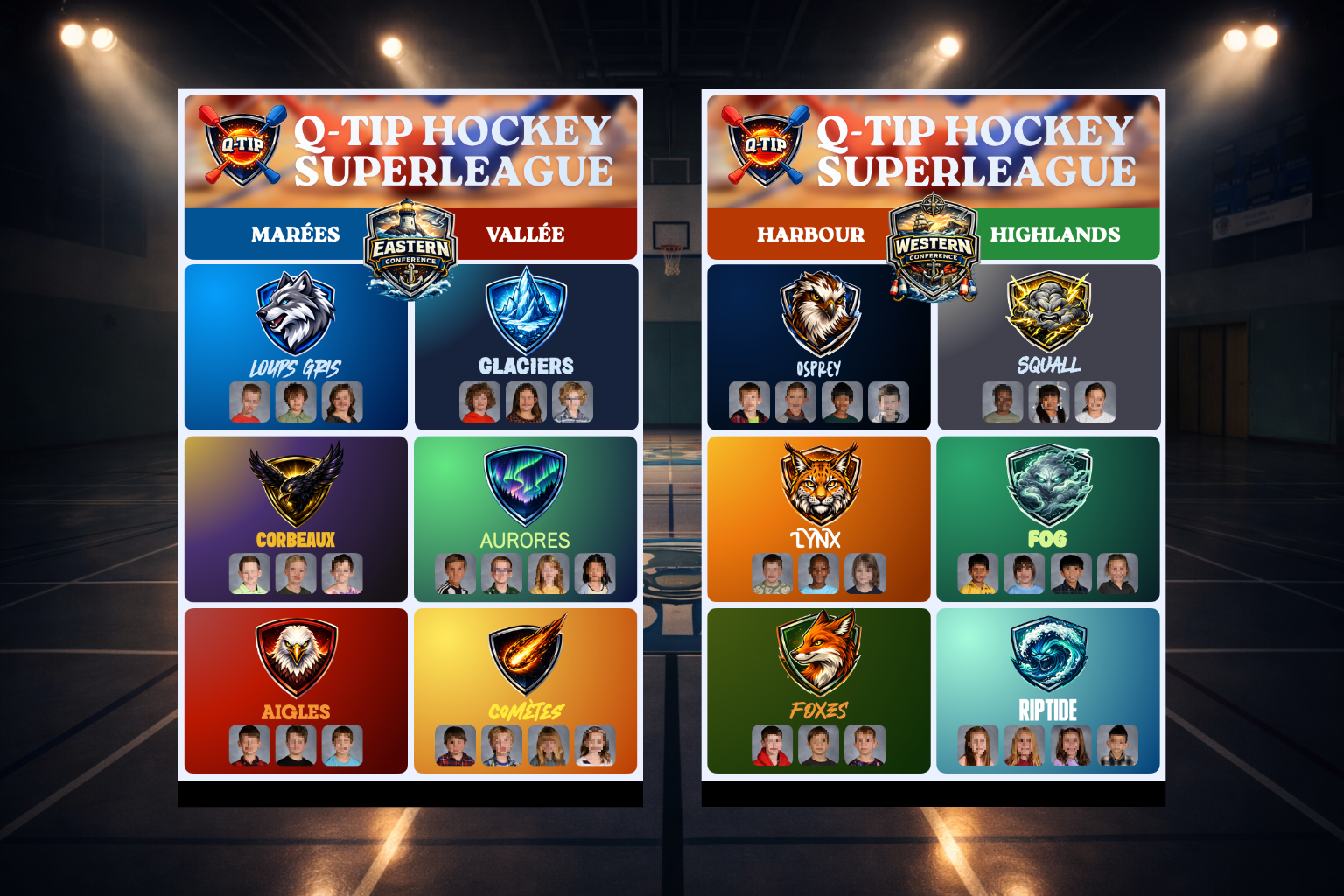
- Eastern Conference: Les Marées (Tides) and La Vallée (Valley)
- Western Conference: Harbour and Highlands
The team and division names were selected to represent Nova Scotian culture and heritage. Again, I was using the sport education model to create meaningful experiences for my students, and promoting a sense of place helped keep things personally relevant.
Each team had a custom logo and I created Q-Tip Roster Sheets so that the kids could become familiar with their teams, divisions, conferences, and the league:
To promote team affiliation, every student received stickers with their team logo on them. The kids were PUMPED about these stickers and were quick to add them to their water bottles, pencil cases, etc.

You'll notice that teams were small: only 3 or 4 players each. I decided to go with small-sided teams to ensure that every player had to contribute both in the games and through their roles. The whole point of this was for students to feel like active members within their sport organization, and small-sided teams helped us achieve this. That said, things did get a bit complicated when students were absent. When this happened, I would pull kids from the opposite division to fill in during games and duty roles.
One last thing: I decided to go with one "advanced" division and one "developmental" division in each class. The students were not made aware of this. The reason why is, again, because I wanted each kid to feel like they were actively contributing to their team. Throughout the season, I had students who are normally shy and quiet in class suddenly become leading goal-scorers and beasts on the court. Setting kids up for games that were within their current skill level led to everyone's confidence growing by leaps and bounds throughout the season. I was very happy with my decision and would 100% go this route again.
Pre-Season: Getting To Know The Q-Tip Superleague
Our season started off with guided practice focused on stick handling, passing, receiving, and shooting. Slowly but surely, students were introduced to the rules and gameplay of Q-Tip Hockey. The four roles (player, coach, referee, scorekeeper) were introduced on Lesson 2 and practised on Lesson 3. Props made the roles feel real: referees got electronic whistles and referee shirts, and scorekeepers got a clipboard and tally sheet.
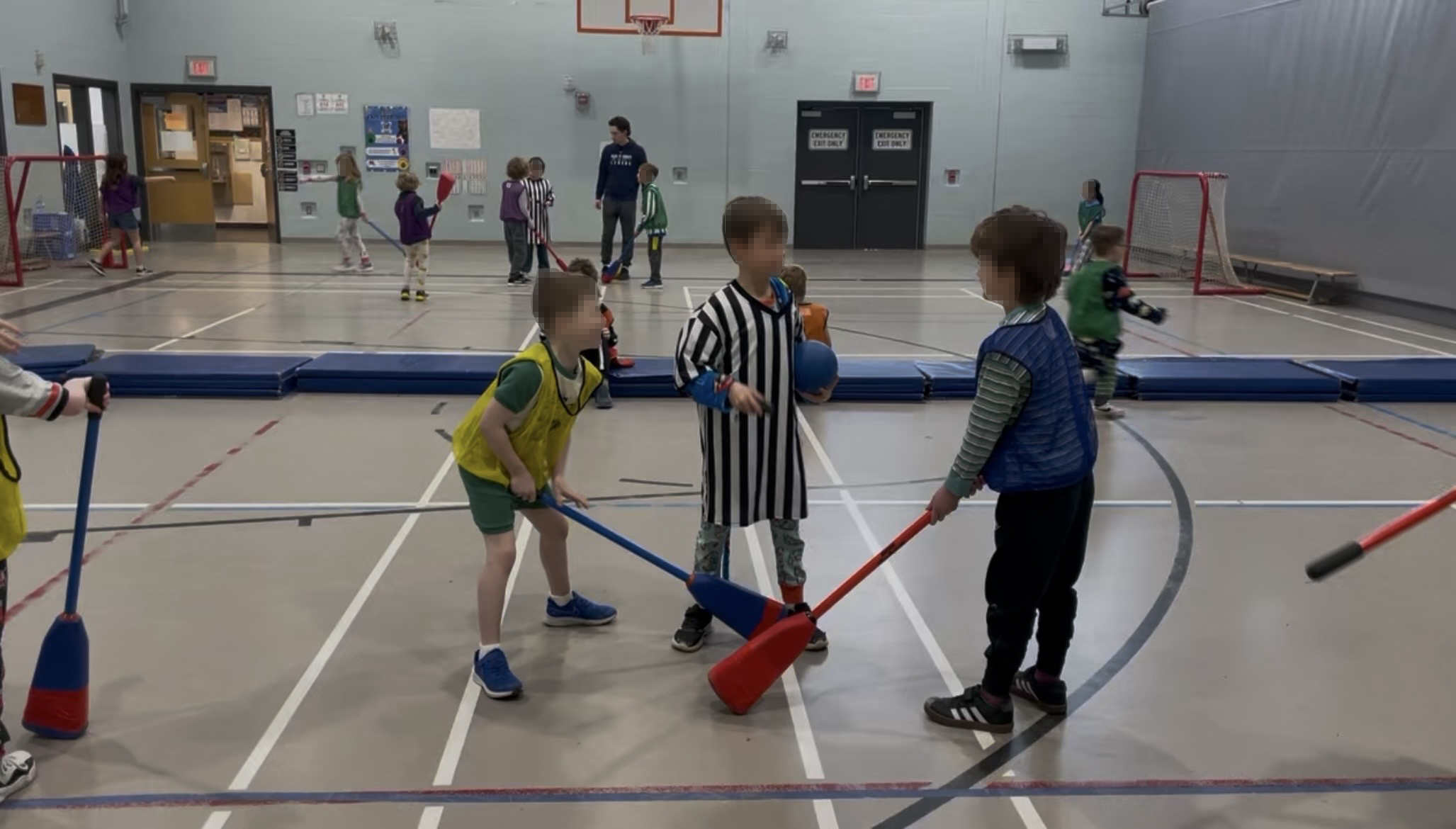
Lessons 4 and 5 were additional preseason exhibition games that served as dress rehearsals. These were added because students needed more time with the coaching role and not all students had practised refereeing and scorekeeping yet.
Season Play
Since there were only three teams per division and since teams would only play other teams from their division, I decided to structure our season as a double round robin within each division (each team played every other team twice). This meant that each team's season would consist of six games total, run across three game days with two games per division per lesson.
Both conferences started their season on the same day (Friday, April 10) and finished on the same day (Friday, April 17 for Championship Day). Our championship points system worked like this:
- 2 points for a win
- 1 point for a tie
- 0 points for a loss
I decided to use fair play points (starting at 3, deducted for poor sportsmanship) as the first tiebreaker. Goal differential was the second tiebreaker.
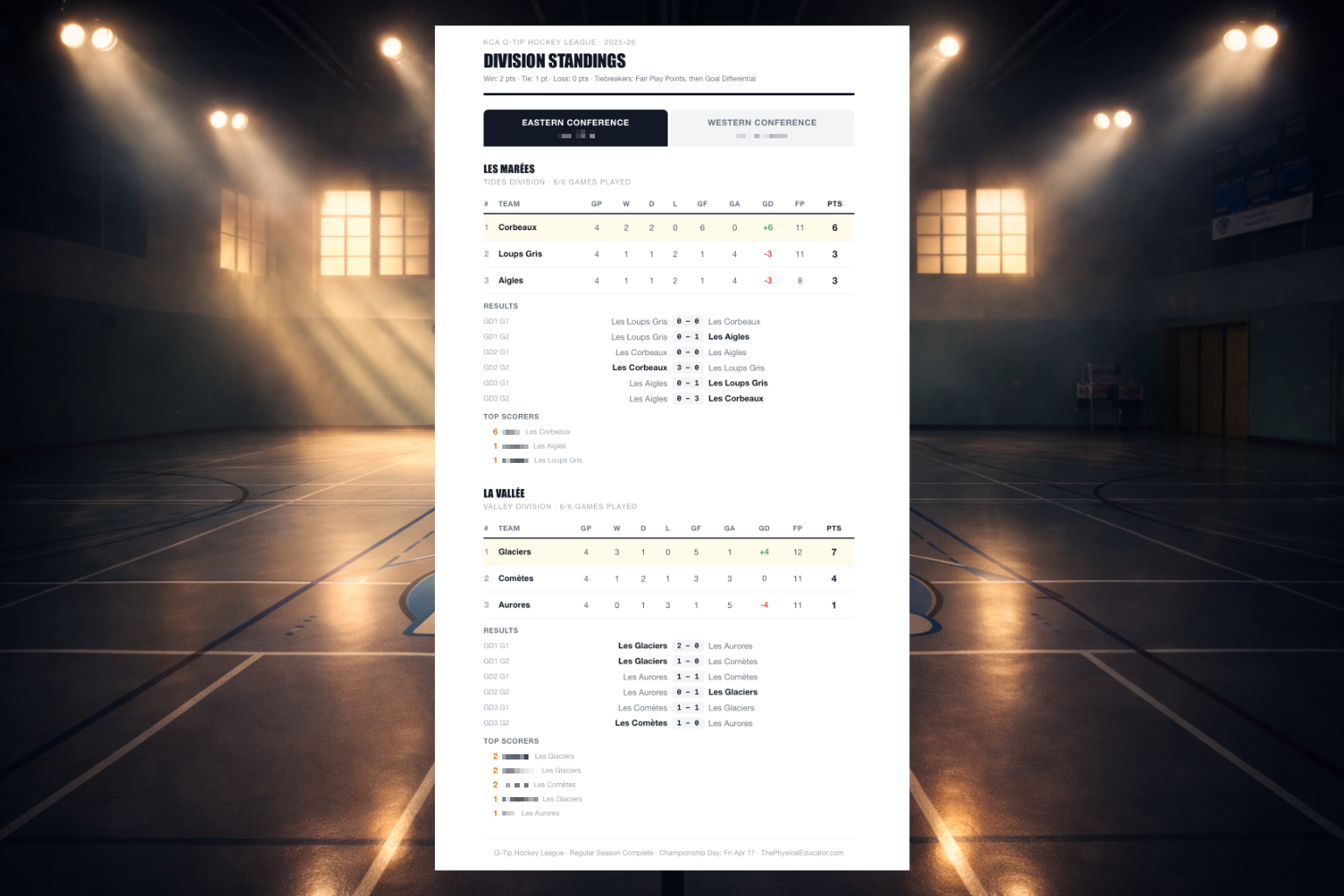
A few moments from the regular season are worth highlighting. Fair play points ended up being more than just a tiebreaker: in one division, a team lost enough fair play points across the season to drop from a potential 2nd place finish all the way to 3rd. When students saw that reflected in the standings after game day 2, the closure reflection conversation shifted entirely. They stopped talking about behaviour in the abstract and started talking about what it was costing their team. That was one of the most powerful moments of the whole unit. On the schedule side, disruptions on the final game day in the Western Conference led to two divisions playing doubleheaders, with the same two teams facing each other twice in the same lesson. It was not the original plan, but it produced some of the most dramatic results of the season, including a 3-3 tie that completely shook up one division's standings heading into championship week.
To help me keep track of standings, I used Claude to build a live standings board (built as a React artifact) that tracked results, standings, goal scorers, and fair play points across all four divisions. It was updated after each game day, and I updated it by dictating the results of every game (read from the completed scoresheets) into the chat.
Championship Day
On our championship day, both classes came to the gym together for a combined one-hour block. I asked the homeroom teachers if they minded getting an extra prep in their day, and they were very quick to accept!
We started the championship day by having students from non-finalist teams play in cross-conference all-star jamboree games with hockey-style line changes. These games happened simultaneously and gave every kid an opportunity to play on the final day, as well as a chance to experience playing against students from the other class.
For the finals, the gym lights were dimmed and I got some Jock Jams playing through the speaker. I had each finalist team wait in the bathroom (the tunnel) and used a microphone to introduce each team by name. Players ran out and did laps around their side of the court as the "fans" (all the other students) went wild. The national anthem was played before the first final. We played one final at a time to give each finalist team their chance to shine.
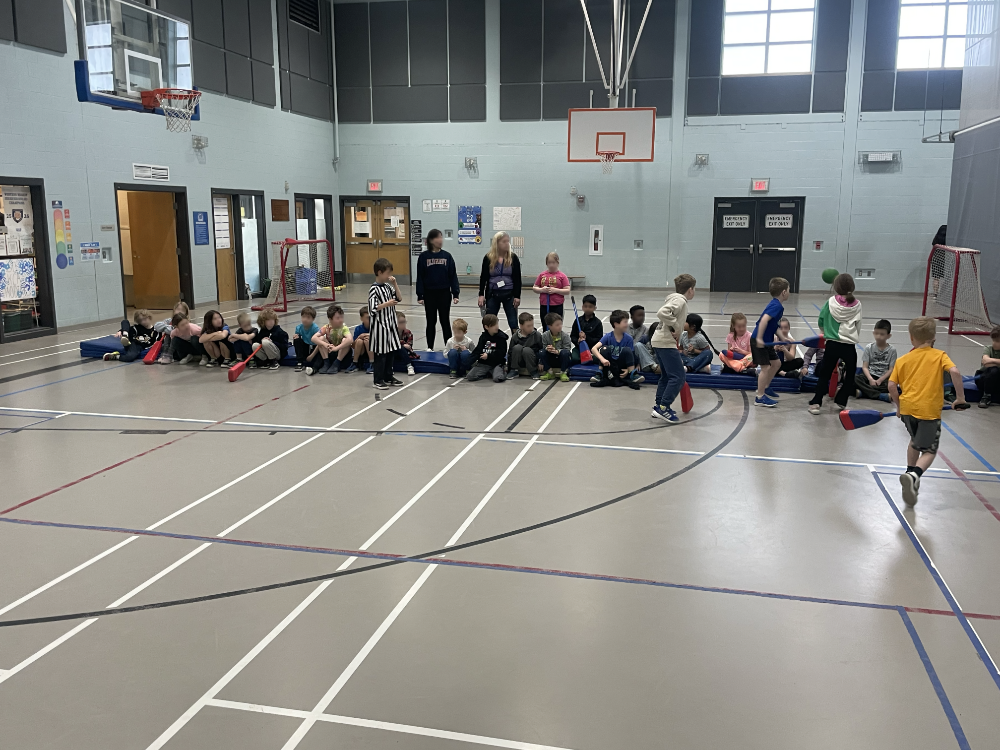
Following the championship games, it was time to move on to the awards ceremony. The following awards were given out with specific reasoning explained for each award:
- Sportsmanship Award (x2)
- Coach of the Year
- Scoring Champion (x2)
Although I didn't give out awards for officiating roles, the two best referees from each conference were invited to referee the finals, which served as its own form of recognition.
Finally, championship certificates were awarded to every player on the two winning teams, which served in lieu of medals or a trophy.
I’ve already started hearing from parents about how much their child’s experience in Q-Tip has helped their confidence, and how much interest they are now showing in sports. Needless to say, all of this work was worth it.
Final Thoughts
This was my first time running a Sport Education season in over a decade. Just as I remembered, it involves a ton of up-front work. That said, unlike the last time I ran SEM in my physical education program, this time I was able to leverage AI to help me plan out the season, roles, duty schedules, and standings. This gave me a lot of extra headspace to be able to dive into the nitty-gritty such as the player roles, rosters, game boards, etc.
I loved how excited the kids got about their Q-Tip league and I was so happy to see students flourish when placed under the right conditions. I've already started to hear from parents about how much their child's Q-Tip experience has had a positive impact on their confidence and interest in sport!
I'm looking forward to making this Q-Tip Hockey SEM season an annual addition to my PE program. I'm also looking forward to it not being as heavy of a lift next year now that so many of my resources are made!
I'd be happy to answer any questions you may have regarding my experience with sport education in lower elementary, so please feel free to drop your questions in the comments below!
As always, thanks for reading and Happy Teaching! 🏒


