


When I started teaching at Kings County Academy (KCA), I walked into a teaching reality that I knew existed but never really got to experience:
⏱️ Thirty-minute lessons.
🔁 Revolving door schedule.
😰 Back-to-back classes with no breathing room between them.
To add to this madness, I was now teaching exclusively the very-well-emotionally-balanced-and-responsible-decision-making kids of primary (a.k.a. kindergarten) to grade two.
I love teaching. I love helping kids learn to move confidently, to understand games, to develop skills that will serve them for life. But in those first weeks at KCA, I found myself spending more time managing social and emotional conflicts than actually teaching physical education.
A student upset because there weren't enough basketballs. Two kids arguing over whose turn it was. Someone crying because their friend wouldn't play with them, or because they missed their mom, or because it was cloudy outside...
Listen, I'm not trying to downplay students' emotional needs. These moments matter, and I believe deeply in social-emotional learning as part of a well-rounded education. But when every lesson felt like crisis management, when the carefully planned learning experiences I'd prepared were constantly interrupted, something had to change.
I was struggling and needed a different approach. Not one that ignored social-emotional development, but one that created dedicated space for it without sacrificing my instructional time.
The Role of Play in Social and Emotional Development
Before I explain what I did, I want to talk about free play and its role in child development.
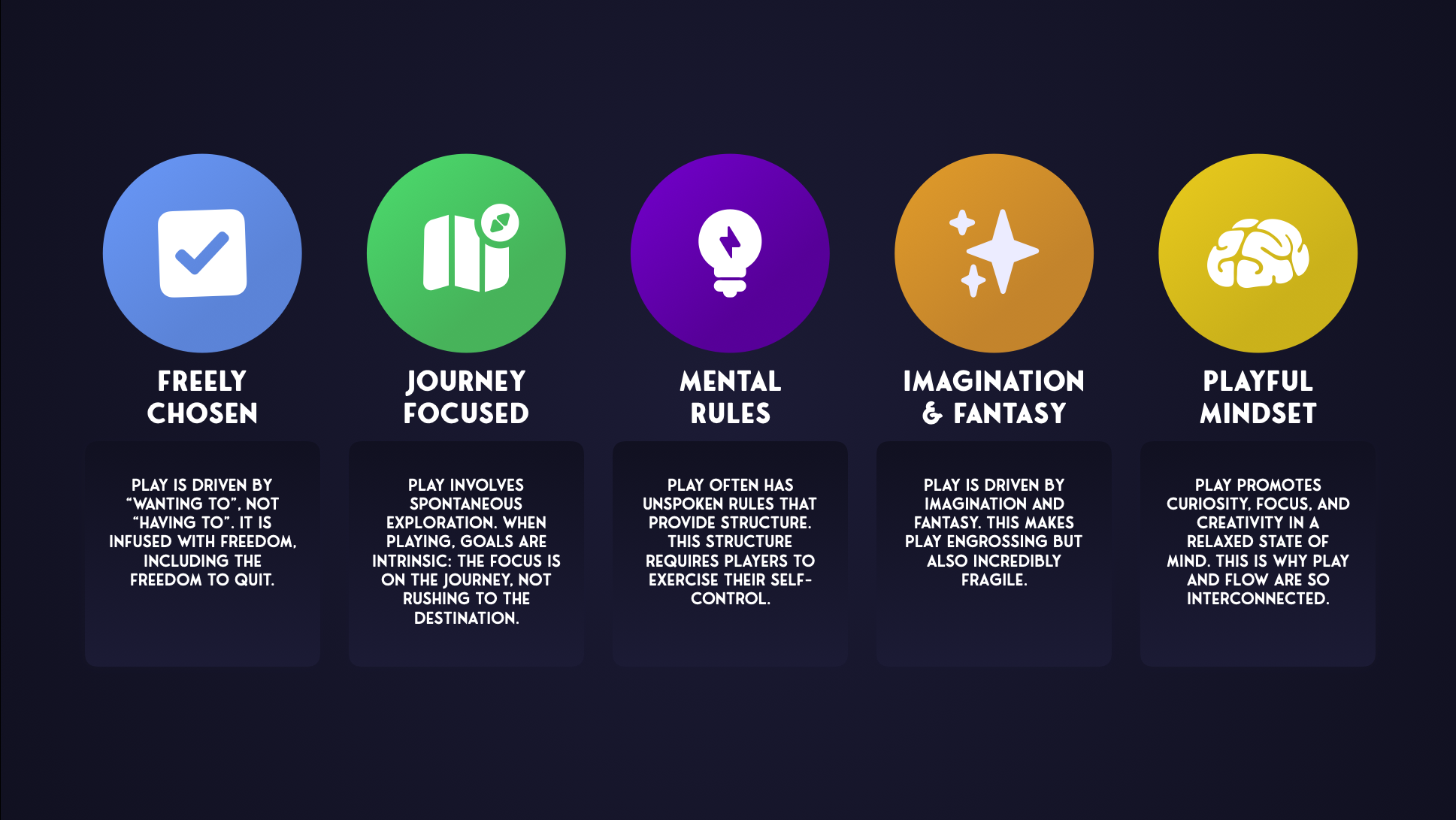
Peter Gray, a research professor at Boston College and author of "Free to Learn," defines play as "activity that is self-chosen and self-directed, done for its own sake rather than as a means to an end". Real play, according to Gray, has five essential characteristics:
- Self-chosen and self-directed: Players decide what and how to play
- Intrinsically motivated: Done for its own sake, not for external rewards
- Guided by mental rules: There's structure, but it's flexible and negotiable
- Imaginative: Involves some element of make-believe or creativity
- Conducted in an alert, active, but non-stressed frame of mind: Serious but not stressful
When kids engage in free play, it can look a lot of different ways:
💪 Physical play (i.e. kids wrestling and chasing).
🏀 Object play (experimenting with balls, hula hoops, and scarves).
👬 Social play (pickup basketball games, collaborative challenges).
🪄 Imaginative play (creating games, building obstacle courses, storytelling through movement).
⚠️ Risky play (play at height, speed, with dangerous tools/elements, rough and tumble, getting lost, or with impact)
The research on the role of play in social and emotional development is compelling, and it kept showing up everywhere I looked.
Peter Gray's work in "Free to Learn" argues that children are designed by nature to develop the social and emotional skills they need through play. Through play, kids learn to regulate their emotions, negotiate with peers, take others' perspectives, and work through conflicts. We (i.e. human beings but also lots of living creatures) have been doing this for thousands of years.
Lenore Skenazy and the Let Grow project highlight how we've systematically removed opportunities for unstructured, unsupervised play from childhood. Kids today have far fewer chances to play freely with peers, to work through problems independently, to experience the kind of healthy struggle that builds resilience.
Jonathan Haidt's "The Anxious Generation" connects these dots even further. He argues that the rise in anxiety and depression among young people isn't coincidental. We've created a world where play doesn't exist for children in the way it used to, and we're seeing the consequences in their mental health and social development.
The question that kept circling in my mind was this: If children are designed to develop social and emotional skills through play, why aren't we using play as a high-leverage tool in our teaching?
That's when I discovered Free Enterprise Time.
Free Enterprise Time: The Foundation
At the National PE Institute in Asheville, North Carolina, I attended a presentation by Megaera Regan and Adrienne Ferretti that changed how I approach SEL in my teaching. They shared an approach they'd developed over decades called Free Enterprise Time.
The concept was beautifully simple: dedicate time at the beginning of each PE lesson for student-directed free play. Not structured activities. Not teacher-led games. Not even "choice time" where students pick from predetermined options. Actual free play where students decide what to do, how to do it, and who to do it with.
Their argument was rooted in the same research I'd been reading. Students develop socially and emotionally through play, not just through explicit SEL instruction. By intentionally bringing play back into the school day, into the PE setting, we give students the space they need to develop these critical life skills.
It resonated immediately. This wasn't about abandoning my instructional goals or pretending that social-emotional issues didn't matter. It was about creating a dedicated container for that development so it had room to breathe and allowed for students to self-regulate prior to my carefully planned lessons.
I went home from that conference and started planning how to make this work at KCA.
Introducing Treasure Time
Treasure Time happens at the very beginning of every lesson. Students walk into the gym and immediately see the Treasure Box (a large container filled with equipment... more on that in a bit), and they know they have 7-10 minutes (sometimes as short as 5, depending on the day) for free play.
Here's what makes Treasure Time work:
The Two Rules
I keep the rules as simple as possible. There are only two:
Rule 1: Nothing dangerous. You can't do anything that could hurt yourself, hurt someone else, or break something in the gym.
Rule 2: Don't leave the gym without telling me. If your ball rolls into the hallway or you need to retrieve something, you have to let me know first.
That's it. Within those two boundaries, students can play however they want (I even let them play fight... which is a form of rough and tumble risky play).
The Lifeguard Role
This might be the most important part of how Treasure Time works. During these minutes, based on what I've learned from the Let Grow project, I take my teaching hat off and put my lifeguard hat on.
What does that mean? It means my only job during Treasure Time is to save lives. If someone is actually hurt, I deal with that. But if you're upset because there aren't enough basketballs? If you're in a conflict with a friend? If someone won't let you join their game? Those are problems you need to work through on your own.
I'm not there to solve social or emotional problems. I'm not there to make sure things are fair. I'm not there to mediate every disagreement. I'm lifeguarding.
This was hard at first. My instinct as a teacher is to jump in, to fix things, to help. But holding this boundary is what makes Treasure Time so powerful. Students need the space to struggle, to work through challenges, to figure things out independently.
The SEL Support Tools
Of course, I don't just throw students into free play with no support. Over the years, I've developed a set of tools that students can use during Treasure Time (and throughout our lessons) to help them navigate social and emotional challenges.
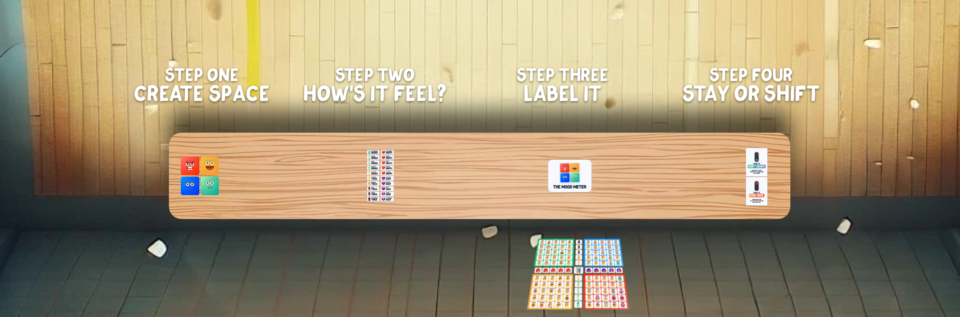
The Breather Bench is based on Marc Brackett's work in "Permission to Feel" and the RULER framework from the Yale Center for Emotional Intelligence. It's a physical space in my gym where students can go to self-regulate using the Mood Meter tool.
The critical thing about the Breather Bench is that it's not a consequence. It's a tool. When students use it, they don't need my permission to return to play. They follow the guided process on the bench, and when they feel ready, they can rejoin the activity or continue sitting with their feelings.
You can learn more about the Breather Bench in this blog post.
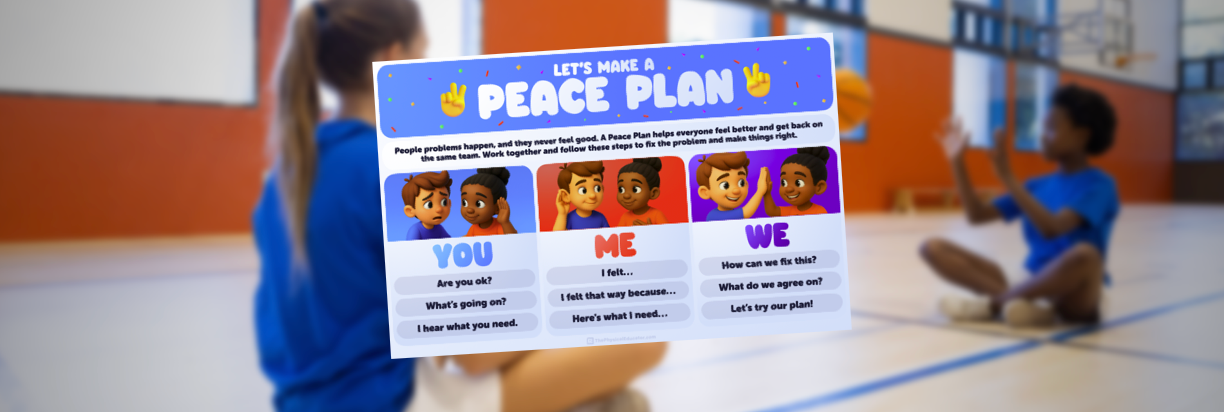
The Peace Plan evolved from Ben Landers' Conflict Corner ideas and incorporates elements of RULER's "The Blueprint" framework. It's a guided process that walks students through empathy building, perspective taking, and conflict resolution. When students come to me with a social conflict during Treasure Time, I ask: "Have you tried the Peace Plan?"
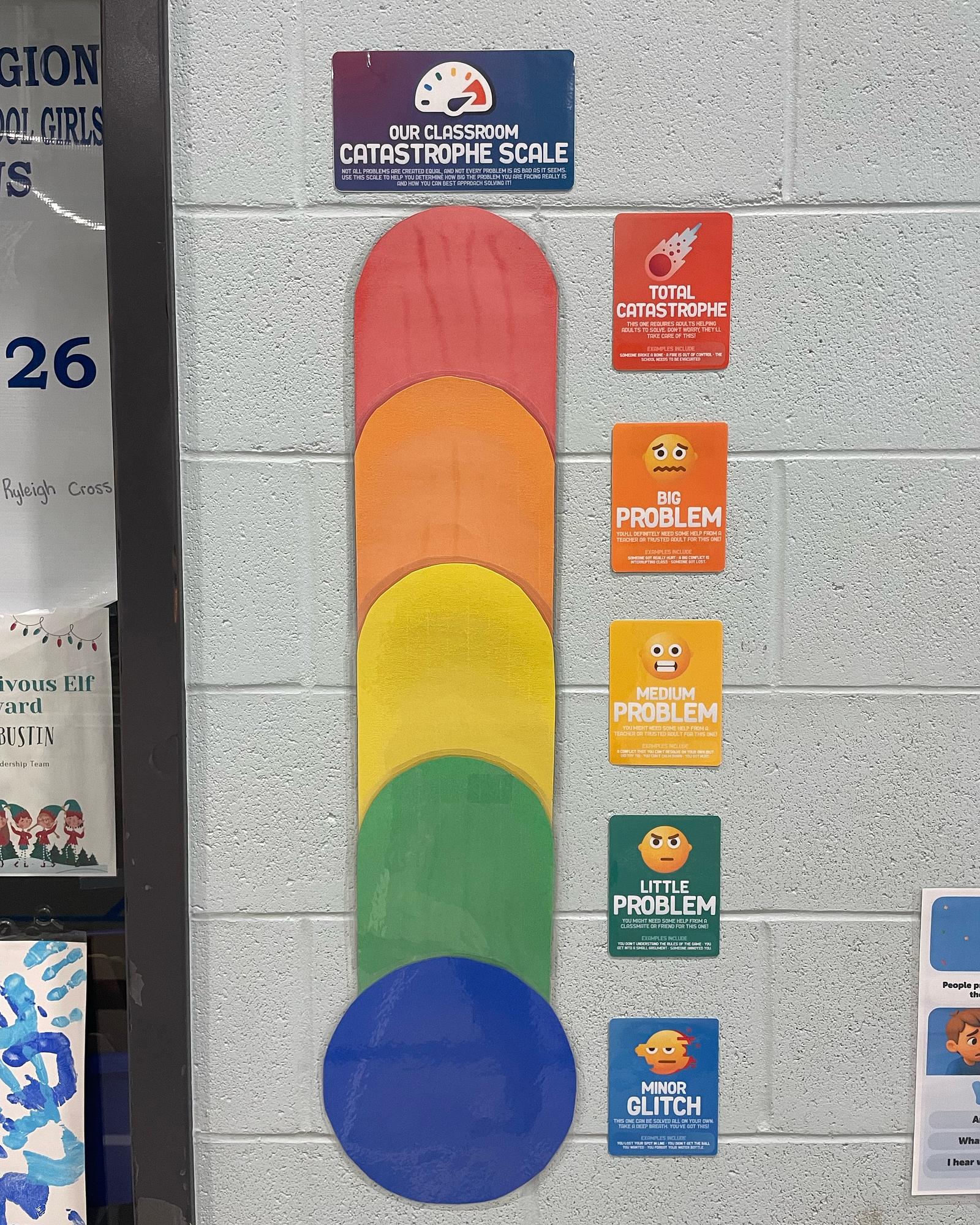
The Catastrophe Scale – which is an idea I originally stumbled upon on Instagram and, for the life of me, cannot find the source – helps students calibrate how big their problems actually are. Is this a genuine emergency, or is it something you can handle on your own? This tool builds perspective and emotional regulation.
During Treasure Time, when students come to me already emotionally heightened or in conflict with peers, I redirect them to these tools. "I'm sorry, I'm lifeguarding. Have you used the Breather Bench? Have you tried the Peace Plan?"
These systems allow students to develop skills, overcome challenges, and hopefully internalize these processes so they no longer need the physical tool. In other words, they're able to engage in self-regulation independently.
The Treasure Box
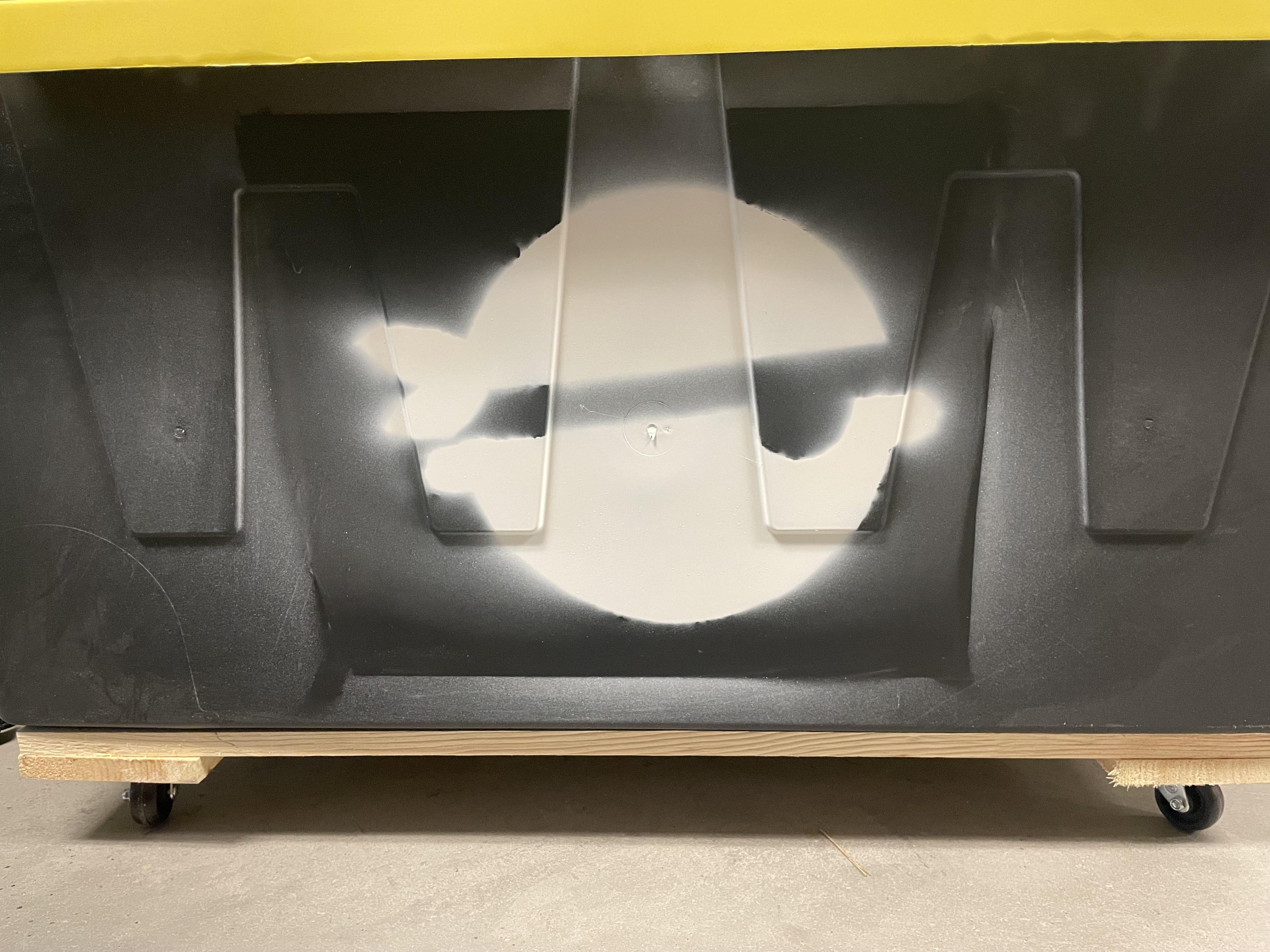
To build my Treasure Box, I bought an extra-large HDX tote from Home Depot (I'm obsessed with totes), built a frame on the bottom of it, and added caster wheels to it.
I then designed a Treasure Time pirate logo which I spray painted onto the side of the tote.
The equipment in the Treasure Box changes regularly, but I'm strategic about what gets introduced and when.
First off, there's always scarcity. There's never enough equipment for everybody to have their own ball or hoop. This is intentional. Students have to learn how to share, how to ask "Can I play with you?", how to let go of the feeling of missing out.
I'm also careful about which equipment gets introduced when. At the start of the year, although I enjoy living dangerously, I'm not putting Frisbees in the box. The students are still learning to play responsibly, to follow the two rules, to be mindful of others in the shared space, and to not lob their teacher's head off with a Frisbee. We talk a lot about how we share this class with other people, and we have to limit the way we're playing so we're not taking away from someone else's playtime or accidentally hurting people.
The equipment ranges from foam balls to stuffed animals to scarves to hula hoops. I include small basketballs, tail balls, scoops, balance stones, and other items. All of this gets rotated through the Treasure Box throughout the year so it always feels a bit new each week.
The Clean Up Cup
The first challenge I experienced with Treasure Time was cleanup. It took forever, and I found myself threatening to take away Treasure Time if students couldn't clean up quickly. That wasn't the energy I wanted.
So I created the Clean Up Cup, a gamified cleanup competition that completely transformed this transition.
Here's how it works:
- At the end of Treasure Time, I use our call to attention ("Three, one, crisscross" / "Applesauce"). Then I ask: "Who's the caboose?" I look around to see who's the last person standing. Being the caboose once isn't a big deal, but if someone is consistently the caboose, it might indicate they're struggling to control themselves and might need some time on the Breather Bench.
- Then I play a song called "Clean Up The Room" (which, according to my Apple Music Recap, is my number one most-played song of the year). The song serves both as a cue to start cleaning and as a timer.
- Students clean up as quickly as they can, putting all the Treasure Time equipment back into the box, then sit down in their squads. Once everyone is seated, I pause the music and check the elapsed time. That's their Clean Up Cup score for the day.
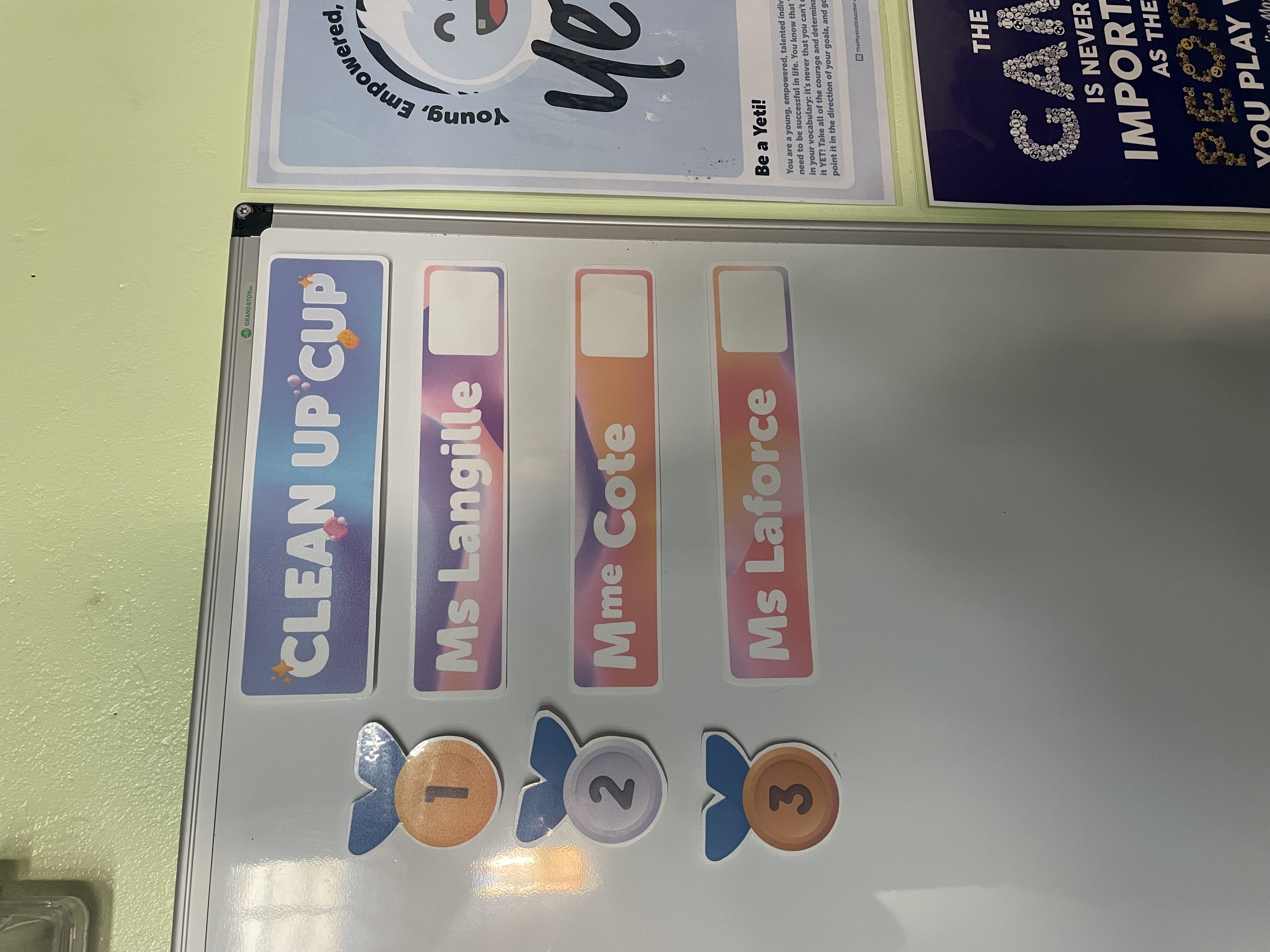
- On my board, I have a Clean Up Cup leaderboard showing first, second, and third place times. If your class makes it onto the podium, I put your class tag up with your score.
At the start of the year, students had to clean up in under a minute to get on the board. Now the threshold is 45 seconds. My average cleanup time is about 30 seconds. It's incredibly fast.
Why Treasure Time Works
After implementing Treasure Time for the past few years, I can identify exactly why it's been so transformative for both my students and my teaching.
For Students
They absolutely love it. The excitement when students walk into the gym and see the Treasure Box is palpable. They want this time. They look forward to it. Free play with peers, the chance to shoot basketballs or start a pickup soccer game or engage in imaginative play, all of it matters deeply to them.
It's low-stakes. If a conflict arises during Treasure Time, it doesn't take away from the actual lesson. This creates the room students need to breathe, to develop SEL skills, to struggle and grapple as they try to figure things out. The learning isn't interrupted. It isn't stunted. There's no time pressure. They get to work through their issues at their own pace.
I honestly can't think of times when students weren't able to figure things out on their own within the 7-10 minutes they have.
Skills develop organically. Students internalize the SEL strategies without constant adult intervention. I watch them voluntarily use the Breather Bench throughout class. I see them reference the Peace Plan when conflicts arise. They're developing agency, learning to solve their own problems, building the skills they need to navigate social situations independently.
For Me
It gives me room to breathe. Teaching a revolving door schedule, managing several classes back-to-back with no breaks, is a grind. Treasure Time gives me time to self-regulate and reset between classes. If the last class didn't go well, I'm able to reset my mood, reset how I'm feeling, and approach the next class feeling fresh and ready.
I deal with significantly fewer SEL interruptions. The amount of conflict I encounter on a day-to-day basis, the whining, the tattling, all of it is substantially less than it used to be. I really credit Treasure Time for that shift.
My responses are less intense. When issues do arise during lessons, they're not derailing my teaching. I'm not frustrated because we're off-track again. There's a dedicated space for SEL development, which means my instructional time stays protected.
I can focus on what I love. The actual lesson. The learning targets. The movement and skill development. The parts of teaching that bring me the most joy. Treasure Time restored that joy by creating boundaries around when and how I engage with social-emotional issues.
Observable Outcomes
The evidence is everywhere when I look for it. Students use the Breather Bench voluntarily. They sit there examining the emojis, labeling their feelings, having quiet discussions about emotions. That tells me it's a tool they genuinely value, not something they're using because I'm making them.
Students resolve conflicts independently during Treasure Time. They use the Peace Plan. They work through disagreements. They figure out how to share equipment, how to include others, how to manage disappointment.
The transitions into lesson time are cleaner. The classroom culture is more positive. The students are more ready to learn when we shift from Treasure Time into our instructional focus.
Getting Started With Treasure Time
If you're thinking about bringing something like Treasure Time into your PE program, here are a few things I've learned:
Start conservatively with equipment. Don't put Frisbees or other complex equipment in the box right away. Build toward more challenging equipment as students demonstrate responsibility and understanding of the two rules. The progression matters.
Hold the lifeguard role firmly. Resist the urge to jump in and solve problems. When students come to you during Treasure Time, redirect them to the tools: "Have you used the Breather Bench? Have you tried the Peace Plan?" Trust the process. Trust your students. The struggle is part of the learning.
Maintain intentional scarcity. There should never be enough equipment for everyone. This isn't a resource problem. It's a pedagogical choice. Scarcity creates opportunities for sharing, collaboration, negotiation, and managing disappointment.
Be flexible with timing. Most days, Treasure Time is 7-10 minutes. Some days it's 5. Adjust based on your class needs and lesson plans. The structure should serve your teaching, not constrain it.
Rotate equipment regularly. Keep the Treasure Box feeling fresh by changing what's available. This maintains student interest and creates new play opportunities throughout the year.
Implement the Clean Up Cup. Honestly, I don't think Treasure Time would be feasible or sustainable without it.
The Bigger Picture
Treasure Time solved a problem I didn't know how to solve. It gave me a way to honour both social-emotional development and my instructional goals without sacrificing either one.
But more than that, it changed how I think about learning in PE. Play isn't a break from learning. Play IS learning. When we give students space to direct their own activity, to work through challenges independently, to experience the kind of healthy struggle that builds resilience, we're teaching them skills they'll use for the rest of their lives.
By stepping back and putting on my lifeguard hat, I give students the space they need to step up. To figure things out. To develop agency and confidence. To become the kind of problem-solvers and self-regulators who don't need an adult to manage every conflict or solve every challenge.
If you're feeling overwhelmed by social-emotional issues in your PE lessons, if you're struggling to find time for both SEL and instruction, if you've lost some of the joy in teaching because you're constantly managing conflicts instead of teaching movement, I'd encourage you to explore what bringing play back might look like in your program.
What might change if you created dedicated space for free play? What might your students learn if you stepped back and let them struggle? What might you discover about your students' capabilities when you give them the tools and the space to use them?
I hope you enjoyed this post and that it gave you a better glimpse into how Treasure Time works in my teaching! If you have any questions, please feel free to share them in the comments below!
Thanks for reading! Happy Teaching!


